Simulate The Future, Innovate With Precision
Replicant™ is a powerful digital twin simulation platform designed to model and test complex systems across air, space, sea, and land domains. It integrates high- and low-fidelity models in a scalable, modular environment, enabling realistic end-to-end simulations, including Hardware-in-the-Loop (HiL) capabilities, for applications ranging from satellite constellations to global ground networks.
What Does Replicant™ Do?
Replicant provides a multi-fidelity simulation environment that seamlessly integrates complex high-fidelity models, such as instruction-accurate emulations of flight processors, with low-fidelity models like MATLAB or Python scripts. With its advanced capabilities, Replicant enables users to create realistic end-to-end system digital twins encompassing ground, space, and user segments, all within a unified environment. Developed under the DARPA Faithful Integrated Reverse-engineering and Exploitation (FIRE) program, Replicant is built with scalability, modularity, and usability as key design principles.
Replicant makes it easier and faster to create digital twins at scale. It was designed to solve one of the hardest problems in space and defense: how do you develop, test, validate, and scale complex systems quickly and confidently?
How It Works
Replicant incorporates high-fidelity physics modeling for multiple domains, leveraging tools like Basilisk for space simulations. Its intuitive workbench GUI allows users to drop in, connect, and design systems from models as needed, while supporting realistic command and control (C2), RF channel simulations, and space link protocols.
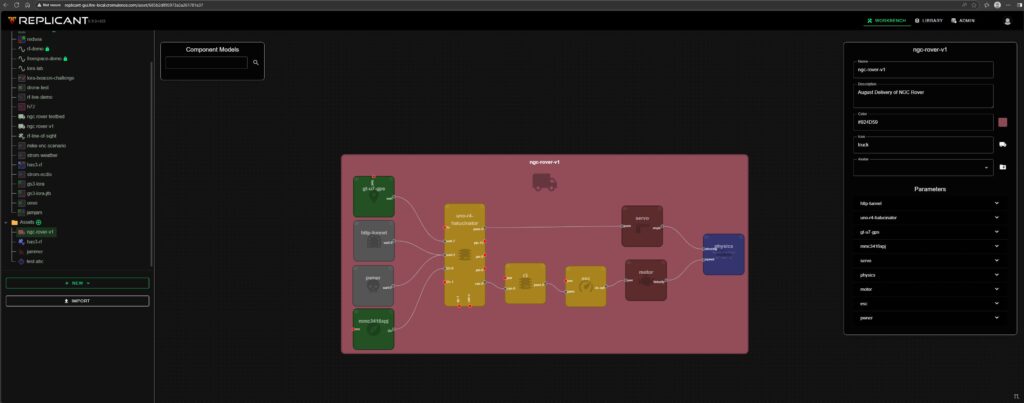
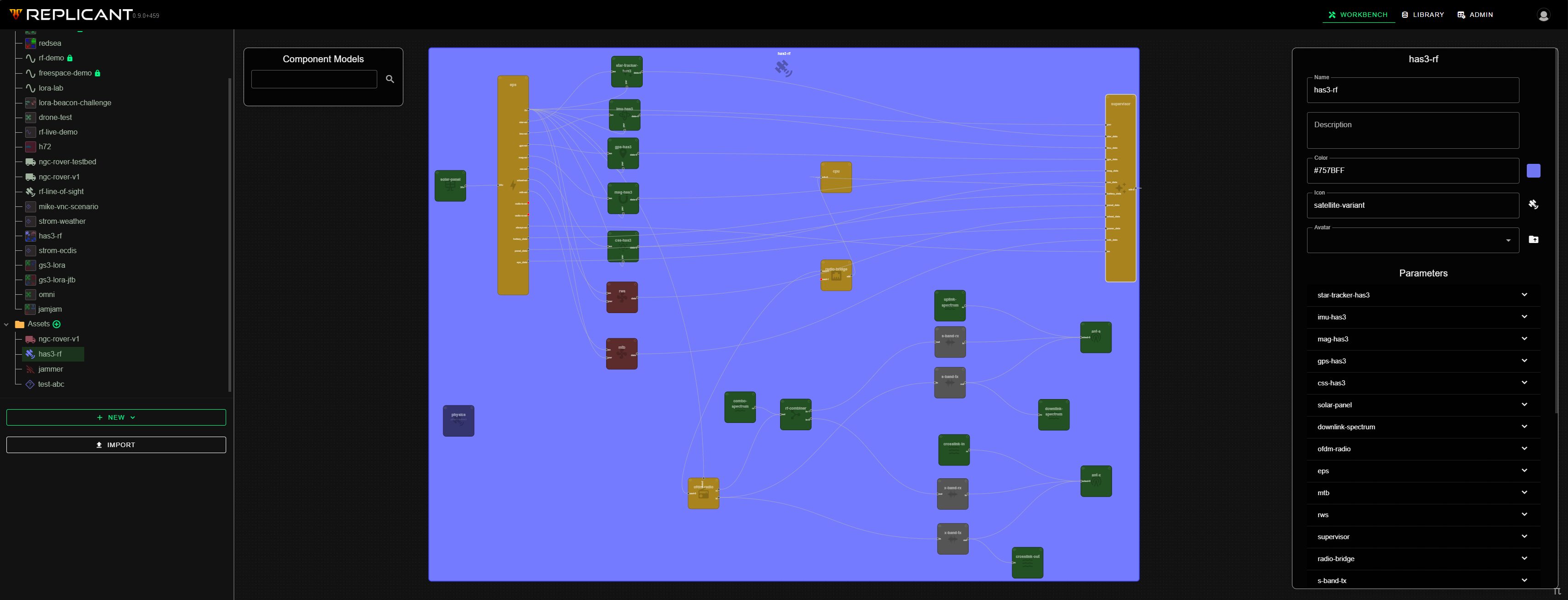
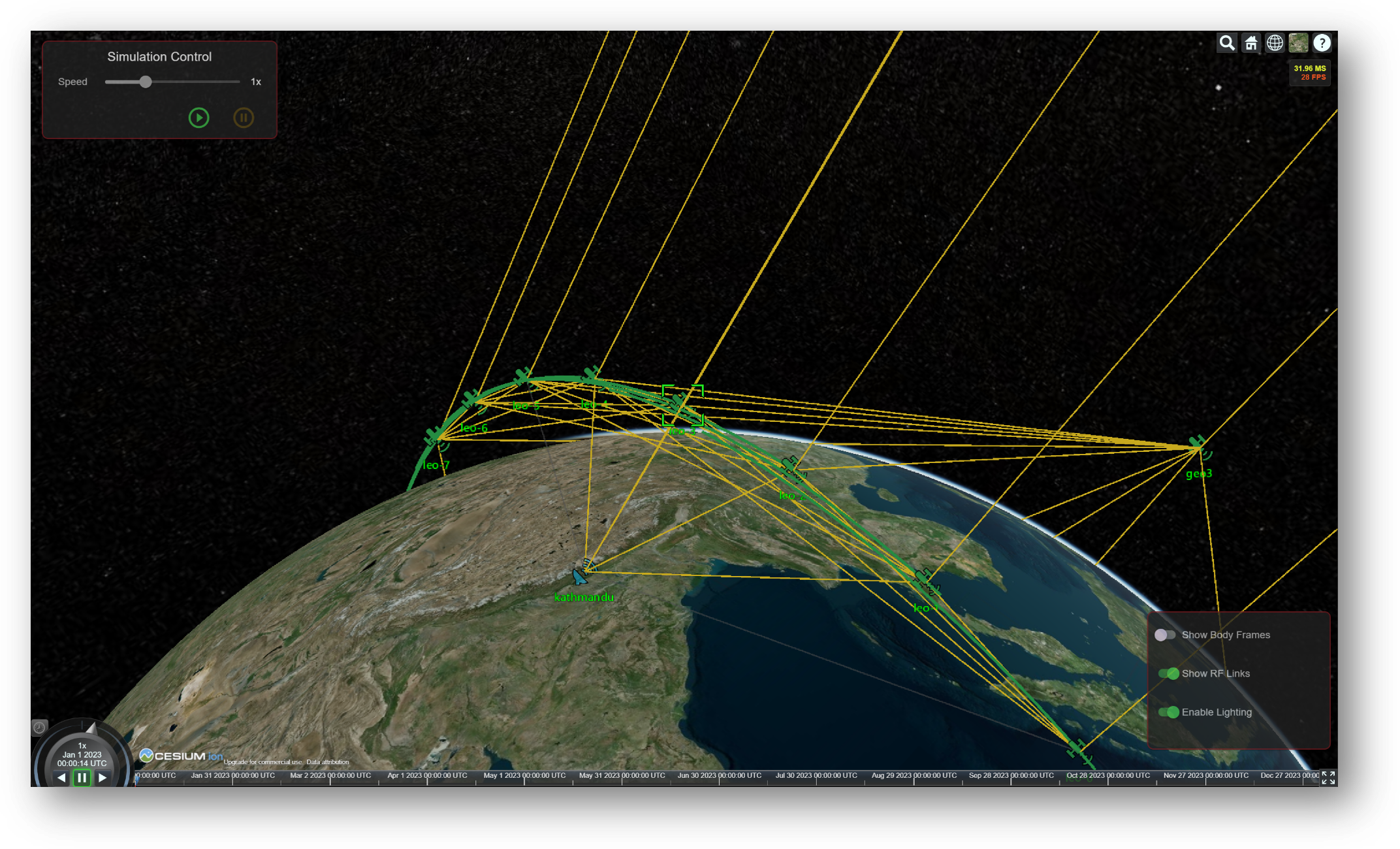
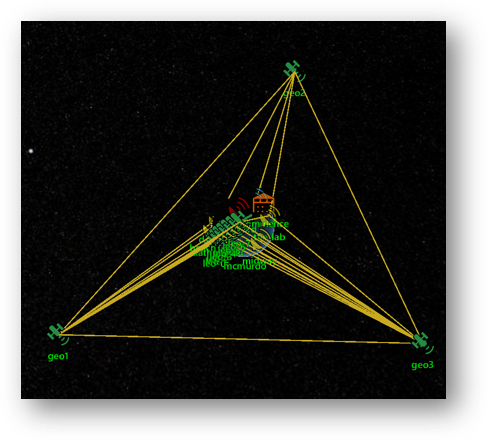
The platform also supports Hardware-in-the-Loop (HiL) mode. This includes FPGA designs, enabling users to replicate single satellites or entire constellations with global ground networks in a combined simulation environment. With many-on-many simulation capabilities, Replicant provides unparalleled flexibility for testing and validating complex systems.
Key Features Of Replicant™
Scalability
Replicant is built on a robust Kubernetes micro-services architecture, offering a web-based interface that can run locally or in the cloud. Its scalability and modular design make it suitable for a wide range of applications, from classified environments to competitive challenges.
Graphical Assembly
Simplified process of building and managing simulations by providing a user-friendly, flow graph-style graphical user interface (GUI). Instead of requiring extensive coding or technical expertise, users can visually assemble and connect components, systems, and models in an intuitive drag-and-drop environment.
Interchangeability of Models
Users can seamlessly swap out one model for another, as long as the models share the same interfaces. This means that components within a simulation can be replaced without requiring extensive reconfiguration, provided they are designed to communicate and interact in the same way.
Mixed Fidelity Library Of Models
Users can flexibly swap between complex, high-fidelity models and simpler, low-fidelity ones based on the specific needs of their simulation. This adaptability ensures efficient resource use while maintaining the accuracy required for the task at hand.
Proven Performance
Whether you’re simulating realistic C2 scenarios or developing digital twins for multi-domain systems, Replicant delivers reliable performance and adaptability.
With its proven track record in DARPA programs and high-stakes competitions, Replicant is the ideal solution for organizations seeking advanced simulation and modeling capabilities.
Example Use Case: Hack-A-Sat
Hack-A-Sat is a cybersecurity competition created to expose and address vulnerabilities in Department of Defense (DoD) satellite systems. The initiative began with a bold idea: prove that satellites can be hacked, and then learn how to defend them.
- Why it started: Satellites are critical to national security, yet they remain vulnerable to cyber threats. Hack-A-Sat was launched to identify weaknesses and strengthen defenses.
- The competition: Over four years, the event evolved into one of the most challenging hacking contests in the world. The DoD partnered with Cromulence (now a part of Parsons Corporation), a team renowned for running DEFCON’s cyber competitions for five consecutive years, to design and manage Hack-A-Sat.
- Historic milestone: In 2023, Cromulence launched a spacecraft into orbit, and for the first time, the competition took place in space—hackers were challenged to interact with a live satellite.
- Next phase: To prepare for future challenges, Cromulence leveraged Replicant to develop and test real satellite systems. Competitors were run against the Replicant satellite, enabling safe, high-fidelity simulations before engaging with hardware in orbit.
Dive Deeper: Space Force Guardians Hone Cyber Defense Skills Using On-Orbit Satellite
In the realm of space operations, the significance of cyberspace security cannot be overstated. Often described as the ‘soft underbelly’ of space operations, it is an area of paramount importance, enabling and supporting space capabilities. To cultivate their expertise, U.S. Space Force Cyber Guardians engaged in a unique training exercise designed to focus on refining the defensive and offensive skill sets of these Guardians. Read more.
How Replicant Supported Hack-A-Sat
Evaluate and Trade Cyber-Physical System Architectures
- Swap models with low, high-fidelity, new capabilities
- Modify, add, remove digital twins
- Simulate faster than real-time
Digital Engineering
- Many digital twins for many developers and platforms (local, cloud, etc.)
- Reduce development hardware needs
- Develop software without hardware and evaluate new software
Mission Planning
- Test commands against the digital twin, not expensive assets
- Digital twins can be broken, inspected, paused, restarted, cloned
Training and Wargaming
- Real-time operator command and control
- Realistic physics, channel modeling, attitude dynamics
Reverse Engineering and Exploit Development
- Find vulnerabilities in the digital twin
- Analyze, test, and prove exploits against a digital twin first
Learn More
Interested in learning more about Replicant™, our digital twin simulation platform? Fill out the contact form to get in touch with us!
Related Products
OrbitXchange™ ↗
We enable global satellite connectivity by offering customers a commercial antenna service that operates in a cybersecure cloud environment.
Ace CtrlPoint™ ↗
Ace CtrlPoint™ is an automated space vehicle and ground station command and control (C2) application.