Parsons Showcases CUAS Leadership At NATO Industry Day In Brussels

Estimated reading time: 5 minutes
We reinforced our position as a global leader in counter-unmanned aircraft systems (CUAS) during NATO’s CUAS Industry Day at the NATO Alliance Headquarters in Brussels. The event brought together more than 100 representatives from NATO, Allied Nations, and industry partners to address the growing threats posed by unmanned aircraft systems (UAS) and explore collaborative paths moving forward. The gathering followed the October 2025 NATO Defense Ministers’ decision to expand the Alliance’s CUAS capabilities.
Highlighting U.S. Leadership and Open Architecture Innovation
We were represented by Dave Boyd, Security and Mission Solutions sector CTO and CUAS SME, and Trina Lawrence, senior director of CUAS business development. Their participation at this event reflects our strong performance and ongoing innovation across multiple CUAS programs.
Dave Boyd served as a panelist for “Open Architecture and Standardization,” where he addressed NATO’s greatest technical challenge of achieving true interoperability and emphasized the critical role it plays in enabling effective collaboration across the defense systems of sovereign nations.
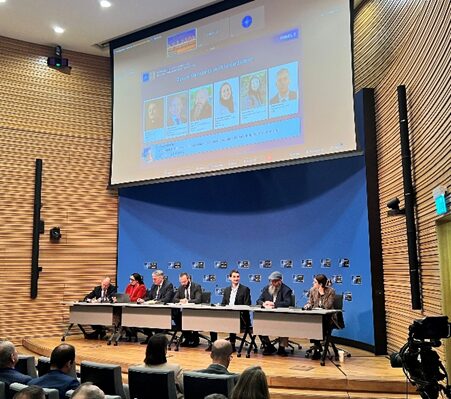
Drawing from our long history of supporting national and international technology standards, Boyd explained, “While many emerging standards define how data and communications protocols are structured, real interoperability also requires a shared understanding of the semantic meaning behind tasks, commands, and sensor behaviors.”
He highlighted NATO’s adoption of the UK-developed SAPIENT standard as a significant step toward enabling two-way communication between sensors and command-and-control (C2) systems. Boyd stated, “For standards to truly accelerate deployment and enhance mission readiness, they must be fully vendor agnostic, enabling nations to mix and match sensors, C2 systems, and effectors without relying on proprietary integration or vendor-specific code.” This open-architecture approach ensures that nations can rapidly deploy, replace, or upgrade components, an essential capability in dynamic battlefield environments.
Proven Performance
Parsons’ invitation to participate in NATO’s Industry Day was driven in part by recent standout achievements on high-visibility CUAS programs.
CUAS Operations – Southern U.S. Border
Our team of experts continues to deliver proven CUAS solutions, including the recent deployment of DroneArmor™, Parsons’ military-grade C2 system, at the U.S. southern border. The Technology Readiness Level 9 (TRL‑9) capability is providing operators with real‑time situational awareness, actionable intelligence, and precise mitigation capabilities against unauthorized or malicious drone activity, protecting personnel, communities, and critical infrastructure.
This work to enhance U.S. national security is one example of our ability to rapidly field and sustain advanced CUAS capabilities in operational environments and is becoming a model for broader federal CUAS missions.
Air Base Air Defense
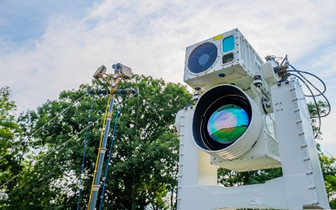
We have played an active role in advancing NATO’s initiatives for air defense and counter-unmanned aircraft systems. Through our Air Base Air Defense (ABAD) contract with U.S. Air Forces in Europe, we recently delivered an advanced early warning capability for NATO’s eastern front, designed to detect and counter both UAS and other airborne threats. Leveraging our open architecture, standards-based approach, we have successfully integrated allied nation sensors into a unified common operating picture (COP) for the theater. Our state-of-the-art cross-domain solutions enable seamless data transfer from unclassified and NATO partner networks to the Air Operations Center (AOC), providing comprehensive, theater-wide situational awareness.
At our Ramstein Air Defense Integration Laboratory (RADSIL), we continue to push the envelope by integrating cutting-edge CUAS technologies, including artificial intelligence and machine learning–enabled autonomy and advanced target identification. Additionally, we are collaborating closely with USAFE to incorporate advanced, low collateral damage mitigation technologies, ensuring effective countermeasures against the rapidly evolving UAS threat.
OSIS (Overseas Systems Integration Support)
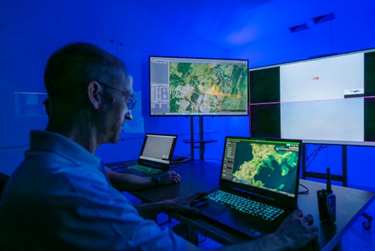
For more than 12 years, we have been instrumental in safeguarding personnel, assets, and U.S. interests at over 265+ diplomatic locations worldwide, including embassies, consulates, and other diplomatic facilities. Through the Overseas Security Installation Services (OSIS II) program, our team delivers a comprehensive suite of technical security solutions, seamlessly integrating advanced automated access control, CUAS, state-of-the-art biometric technologies, and operations support. Each solution is meticulously engineered and customized to meet the Department of State’s dynamic and evolving security requirements.
OSIS II exemplifies our capability to execute full-spectrum engineering, open-architecture integration, advanced analytics, on-site operational support, and long-term sustainment for technical security and CUAS systems across the globe. Managing more than 120 simultaneous projects, OSIS II is recognized as one of the world’s largest and most sophisticated diplomatic security and technical security upgrade and installation initiatives, demonstrating our unwavering commitment to protecting critical U.S. missions and adapting to emerging global threats. These combined achievements formed the foundation for Parsons to represent the U.S. industry on the international stage
Driving The Future Of NATO CUAS Cooperation
NATO’s CUAS Industry Day was the culmination of a weeklong series of Allied discussions focused on accelerating CUAS capabilities ahead of multiple major integration exercises planned for 2026.
A Growing Global Footprint
As drone threats grow in complexity and scale, NATO and Allied partners are increasingly turning to leaders capable of delivering open architecture, mission-proven, and rapidly deployable CUAS solutions.
Through our CUAS Center of Excellence and decades of work supporting federal clients and international partners, we continue to deliver the innovation, speed, and integration expertise needed to outpace evolving unmanned threats.
Learn more about our advanced CUAS solutions here.