APS™: Assured Position, Navigation, And Timing (APNT)
Our Assured Positioning System (APS™) is designed to provide positioning, navigation, and timing (PNT) information under all operating conditions, including in contested environments where GPS or other GNSS (Global Navigation Satellite System) is unavailable or unreliable. APS is available on the Tradewinds Solutions Marketplace and deemed awardable as it addresses the DoW’s most significant challenges in AI/ML, data, and analytics.
Tradewinds Solutions Marketplace Awardable Product

This product has been assessed and approved by the Tradewinds Solutions Marketplace and deemed awardable as it addresses the DoW’s most significant challenges in AI/ML, data, and analytics.
For more information, please review our 5-minute video solution on the Tradewinds Marketplace, part of the DoW’s Chief Digital Artificial Intelligence Office.
What Is APS™?
Breaking Down Our Assured Positioning System (APS)
Reliable positioning, navigation, and timing (PNT) data is essential to the proper functioning of myriad critical applications and missions, and GPS has become the ubiquitous source of accurate PNT information. However, GPS signals and other GNSS signals are vulnerable, and GPS can for many reasons be unavailable or unreliable, including in contested environments where they may be purposely interfered or manipulated.
Our Assured Positioning System (APS™) is designed to provide reliable PNT information under all operating conditions, including in environments where GPS is inaccurate or unavailable. APS operates independently of GPS and other GNSS, so critical applications and systems that depend on PNT data can continue to function when GPS signals are jammed, spoofed, or otherwise disrupted.
How Does APS Work?
APS is a space-based solution and uses proprietary hybrid technology to derive PNT data from signals transmitted from non-GPS/non-GNSS low Earth orbit (LEO) communications satellites operated by a U.S.-based commercial satcom provider and from a non-GPS/non-GNSS geosynchronous Earth orbit (GEO) satcom constellation. The signals leveraged by APS are completely independent of GPS andare not vulnerable to GPS jamming or spoofing.
Additionally, APS can be deployed as a plug-in for the Android Team Awareness Kit (ATAK) on a user's smartphone, providing a seamless path to integrate resilient PNT capabilities into existing operational workflows.
Key Product Features
- Independent backup and/or complement to GPS/GNSS
- Unaffected by GPS/GNSS jamming and spoofing
- Leverages space-based hybrid technology to derive PNT information from signals transmitted from non-GPS/non-GNSS communications satellites
- Supports military and commercial applications
- Reliable PNT support for dismount, mounted, and guidance use cases
- Hosted application for Peanut SDR™; Parsons’ compact multi-mission software defined radio family
Where Can APS Be Deployed?
APS can be implemented by means of either (1) a compact Parsons integrated hardware/software user-equipment (UE) package, or (2) by installing APS application software on compatible non-Parsons UE.
Parsons Integrated Hardware/Software Solution
Third-Party Hardware Integration
Peanut Software-Defined Radio™
Our Peanut Software-Defined Radio (SDR) family of systems (FOS) combines high performance, versatility, and value in space- and power-efficient packages.
Peanut SDRs are equipped with processing power and I/O capabilities to support a wide range of demanding military and commercial RF use cases, including but not limited to alternative and assured positioning, navigation, and timing (PNT), RF situational awareness (SA), tactical edge operations, and complementary precision timing.
Peanut SDRs are available in compact enclosures for both dismounted and mounted use or as an OEM circuit card, providing flexibility to integrate mission-ready RF capabilities into a variety of platforms and applications.
Peanut-D (Dismount)
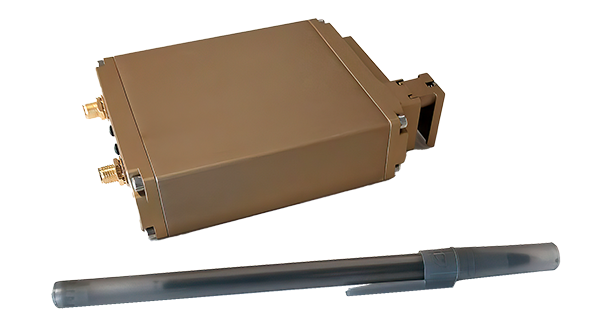
Key Features
- GPS-denied positioning, navigation, and timing (PNT)
- RF situational awareness (SA)
- Tactical edge applications
High-Performance, Very-Low-SWaP-C SDR
- Body-wearable solutions
- Expendable devices
Compact Size & Low Power Requirement
- 3” x 4” x 1” enclosure (also available without enclosure)
- 8 oz.
- 2W average power via USB 2.0 (+5v DC)
Input/Output (I/O)
- 1 Rx port, (325–3800 MHz), +3v DC-biased, SMA-female
- 2x USB 2.0, ethernet (via ext. adapter)
Peanut-M (Mounted)
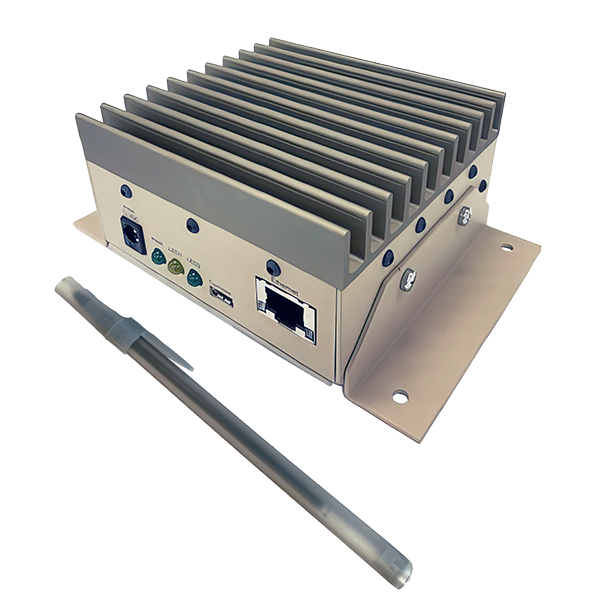
Key Features
- GPS-denied PNT
- RF situational awareness and EW
- Tactical edge applications
- Precision timing backup
- Capacity to accommodate additional signal processing
High-Performance, Low-SWaP-C SDR
- Small UAS deployment
- Mounted platforms
Size & Power Requirement
- 3.5” x 4” x 2” (also available without enclosure)
- 14 oz.
- 6W average power via barrel plug (+8–20v DC)
Input/Output (I/O)
- 2 Rx, 2 Tx, (70–6000 MHz), SMA-female,
+3v DC-biased Rx - 10 MHz and 1 PPS (in/out)
- USB console port
- Gigabit ethernet
Frequently Asked Questions (FAQ)
Explore Related Products And Solutions
Receivers, Transceivers, SDRs and Digitizers
Explore our RF solutions for high-performance radio frequency systems.

Peanut SDR™: Secure, Versatile, And Reliable RF
The Peanut Software-Defined Radio (SDR) family of systems combines high performance, versatility, and value in a space-efficient package.

ER310™ Software-Defined Radio
The ER310™ software-defined radio is a flexible, high-performance, handheld platform designed to host and execute challenging RF applications.
NitroFalcon SDR™
NitroFalcon is a ultra-mini SDR that offers custom communication solutions.

Cyber And Intelligence
We support cyber operations worldwide with leading-edge technical innovations, mission planning and automation solutions, cyber threat intelligence, and advanced cyber threat hunting and incident response.

Advanced Military Cyber Training In The Information Environment
We provide technical and operational services and training and readiness solutions to public and private enterprises.
TAKaaS℠: TAK Integration, Training, And Support For Mission Success
TAKaaS is a service that harnesses the full potential of the TAK (Tactical Assault Kit/Team Awareness Kit) ecosystem.
Learn more about APS™.
Contact us today to learn more about Assured Positioning System from one of our experts.
Request Info