
Estimated reading time: 6 minutes
Global events like the World Cup and Olympics transform cities into complex living systems. As city streets, airport gates, hotels, and venues must handle peak volume, city planners and government agencies face the challenges of managing massive crowds, ensuring security, and maintaining operational efficiency in a short time frame.
In these high-pressure situations, identity verification is more than a checkpoint. It becomes part of a city’s strategic operations to address the challenges of managing massive crowds. When identity verification is fast, reliable, and shareable across agencies, crowds move efficiently, risks are mitigated, and security teams are empowered to focus on critical decisions rather than manual processes.
The Role Of Biometrics In Modern Event Management

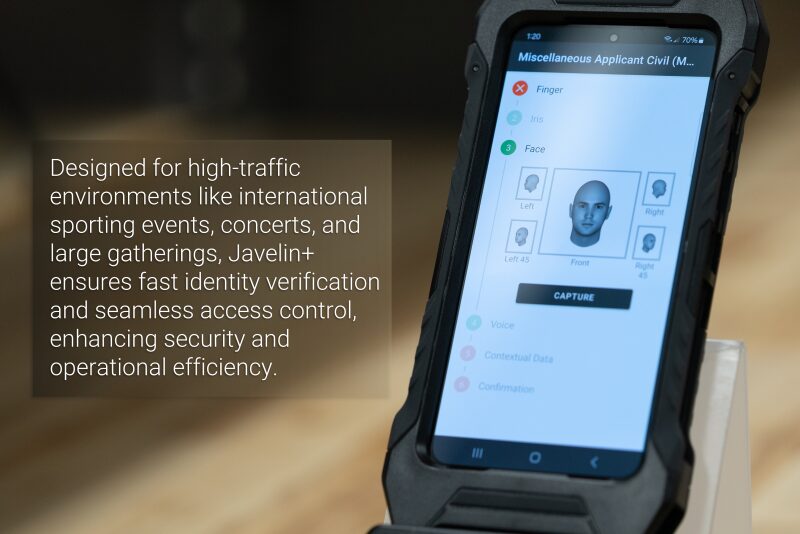
Biometric solutions use unique physical or behavioral characteristics such as fingerprints, facial features, or iris patterns to verify identities. Unlike traditional methods of identification, biometrics offer a higher level of accuracy and security, making them ideal for large-scale events. For example, the use of multi-modal systems, which combine several biometric methods, can quickly verify the identity of a ticket holder using facial recognition, while fingerprint or iris scans can secure access to restricted areas for staff and athletes. Additionally, mobile biometric solutions further empower security teams to confirm identities in the field, providing real-time proof of presence and accountability.
The benefits of biometrics extend beyond security. These systems can streamline operations, reduce wait times at entry points, and provide actionable insights into crowd behavior. For event organizers, this means not only a safer environment but also an improved experience for attendees.
Lessons From Federal Deployments
Parsons’ biometrics and identity management solutions have been tested and proven by federal agencies in some of the most demanding environments worldwide. For instance, the Federal Bureau of Investigation (FBI) employs our biometric systems to support criminal investigations and counterterrorism efforts, enabling rapid identification of suspects and victims. Through its biometric repositories, the FBI provides near-instantaneous responses to law enforcement queries, allowing officers to quickly identify wanted individuals or suspected terrorists in real time.
Another notable example is our Unaccompanied Children Finder (UCF) model, which was designed for the identification, protection, and accountability of unaccompanied minors. It centers on a biometric repository that works seamlessly with the Department of Homeland Security Automated Biometric Identification System (DHS IDENT) and the Homeland Advanced Recognition Technology System (HART).
In another deployment, our scalable solutions enabled secure enrollment and identity validation for more than 100,000 travelers, customized to international standards and sustained six nights per week.
These federal applications highlight the scalability, reliability, and adaptability of biometrics. For large-scale events like the World Cup and Olympics, the same principles can be applied to ensure security and efficiency on a global stage.
Addressing the Unique Challenges of Large-Scale Events
Global events present a unique set of challenges due to their scale, international scope, and diversity of participants. Biometrics technology can address these challenges in several key areas:
- Access Control: At stadium gates, athlete villages, and media centers, biometric systems ensure that only authorized individuals gain entry. Multi-modal verification reduces impersonation and credential sharing while maintaining the flow of people.
- Crisis Management: In emergencies, real-time biometric verification allows security teams to quickly identify individuals and assess threats, enabling rapid and coordinated responses.
- Mobile Operations: Mobile biometric solutions equipped with liveness detection and GPS capabilities provide proof of presence for roving teams, transport escorts, and perimeter patrols. This ensures accountability without adding operational complexity.
- Safeguarding Vulnerable Groups: Scheduled biometric check-ins, such as video liveness detection, create a documented audit trail for minors, volunteers, and contracted staff.
- Data-Driven Insights: Biometric systems generate actionable data that can help organizers understand crowd behavior, optimize operations, and plan for future events.
Blueprint for City Planners
The transition from federal-grade biometric systems to city-scale deployments is straightforward. Many of the components used in federal applications, such as multi-modal biometrics, mobile proof-of-presence, and interoperable repositories, are already in production and can be adapted to meet the unique needs of large-scale events.
For example, credentialing for staff, contractors, athletes, and media can set the baseline for identity verification. Venue entry can be streamlined with rapid face and fingerprint checks, while exceptions are routed to secondary screening without disrupting flow. Mobile applications can validate the presence of roving teams, ensuring that operations remain accountable and efficient.
However, implementing biometrics at this scale requires careful planning and collaboration. Event organizers, government agencies, and technology providers must work together to ensure that systems are interoperable, secure, and respectful of privacy. By taking a thoughtful approach, stakeholders can leverage biometrics to not only address immediate challenges but also set a new standard for event management.
Why Biometrics Matter
For decision-makers, the value of biometrics lies in its ability to address the dual priorities of security and efficiency. A single security breach or logistical failure can have far-reaching consequences, from reputational damage and financial losses to serious injuries or even loss of life.
Moreover, the benefits of biometrics extend beyond the event itself. By investing in these systems, cities can create a foundation for smarter, safer infrastructure that can be used for future events and day-to-day operations. This long-term perspective ensures that investments in biometrics deliver lasting value.
Opportunity and Responsibility
The World Cup and Olympics represent the pinnacle of global events, bringing together people from all corners of the world to celebrate sport and culture. But with this opportunity comes significant responsibility. By embracing biometrics technology, city planners and government agencies can ensure that these events are not only successful but also secure, efficient, and forward-looking
Our comprehensive suite of identity management services is at the forefront of modern authentication technology. We leverage multi-modal biometrics matching to provide highly secure and accurate identification of individuals. Learn more