Strategic Sewerage Tunnel Construction – Dubai, United Arab Emirates (UAE)
Client

- Dubai Municipality (DM)
Project Value 
3.2 Billion
Market

Energy And Environment, Tunneling, Water And Wastewater
Services

Design, Program/Construction Management (PM/CM)
In 2016, we were awarded the Dubai Strategic Sewerage Tunnel (DSST) project by the Dubai Municipality (DM) to develop and implement a deep sewerage system that supports Dubai’s long-term 50-year master plan. The project is divided into two major catchment areas, Deira and Bur Dubai. The project entails two deep wastewater tunnels, associated pump stations, and link sewers that will convert Dubai’s lift-station network into a full gravity system. Once complete, it will eliminate over 100 existing pump stations, cutting wastewater treatment costs, power use, and carbon emissions while supporting Dubai’s long-term population growth.Careful Planning Is Key To Success
Building such a large and important piece of infrastructure requires careful planning – to make sure that it is built correctly and that it meets its intended purpose. Therefore, we undertook extensive master plan flow forecasts and feasibility studies to check that our design met planning parameters and forecast methodologies. This involved liaising extensively with local developers to incorporate updated population and land-use projects into our model. Our design and construction methodologies also required detailed planning. For example, we carefully selected shaft sites so that we minimized traffic disruptions and inconvenience to the public. And we adopted a deep tunnel design to mitigate surface disruptions, as compared with traditional open-cut construction techniques. Sustainability was another focus. The project incorporates sustainable characteristics focused on reducing energy requirements.
Planning for Dubai’s Future Wastewater Needs
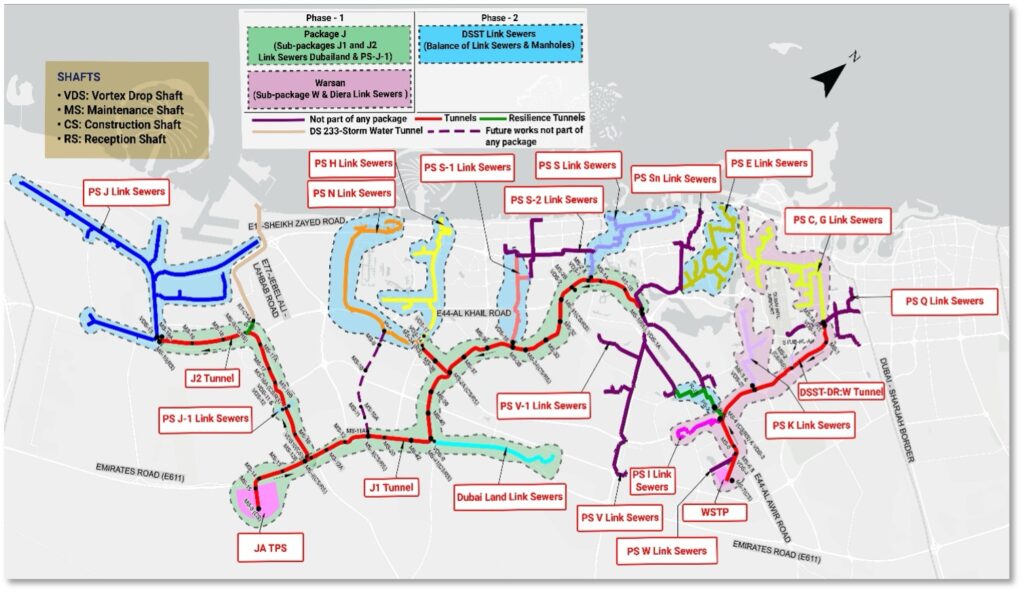
Our scope included updates to the master plan flow forecasts, feasibility studies, preliminary design, tender preparation, program management for the detailed design consultants and design-build contractors, and construction supervision of the primary tunnels and terminal pumping stations, transforming the existing sewerage infrastructure system from a pumped system to a gravity sewer system. We also conducted studies to optimize the current functionality of WSTP and JSTP as part of synergizing the existing facility with the tunnel system in the future. Other studies include stormwater relief management, sewerage infrastructure system policy, financial modeling, environmental impact assessment, and system resilience through risk assessments. We were also responsible for implementing an innovative project management information system (PMIS) with building information management (BIM) capabilities and conducting public engagement plans for the project.
The first project task was to review the prevailing master plan parameters and forecast methods, extending them for a longer planning horizon and wider catchment area. Both community-based and land-use-based approaches were compared to achieve accurate flow projections. We also conducted an extensive outreach program with local developers to update population and land-use projections. The catchment areas of the Sewage Treatment Plants (STPs) were re-evaluated and optimized to support future expansion based on land availability . Sensitivity analyses assessed risks associated with population and flow changes, including growth rates, land use, demographics, and sewage and recycled water (RW – treated sewage effluent) generation and demand. The outcome provided built-in mitigation measures to accommodate potential variations in future forecasts. We also expanded the hydraulic model to include pipes as small as 400 millimeters in diameter.
Evaluating the Sewerage System
The feasibility stage evaluated alternatives for tunnels and link sewers, comparing options such as a single terminal pump station versus multiple interim pump stations, regional versus centralized treatment plants, and gravity versus pumped systems for outlying areas of Dubai. It also reviewed the existing RW network and assessed the project’s impact on RW management.
Designing the Deep Tunnels and Pump Stations
The deep tunnel diameter ranges from 3,500 to 6,500, designed to meet minimum flow, slope, and velocity requirements for a gravity sewer system. Final sizes are based on updated projected flow rates and hydraulic conditions from project modeling. The tunnels will extend over 75 kilometers, supported by 220 kilometers of link sewers and two terminal pumping stations.
Tunnels larger than 3,500 millimeters will be bored using modern tunnel boring machine (TBM) technology, while link sewers will use mini-TBM, micro-tunneling, or pipe jacking methods. Tunnel depths range from 30m below ground level (bgl) to over 100 m bgl. Two terminal pumping stations will be constructed at the WSTP and JSTP, approximately 85 and 115 meters below the surface. We coordinated with authorities to secure preliminary no objection certificates (NOCs), identify utilities to avoid, and finalize layouts for the tunnel and receiving shafts.
We prepared a design criteria report outlining asset life parameters and specifications for the preliminary design of tunnels, shafts, and associated infrastructure, which also forms the tender-stage specifications. . A geotechnical desktop study was additionally developed, followed by the issuance of tender documents and oversight of the drilling program, which produced the geotechnical factual and baseline reports. This information was used to evaluate the predicted tunneling strata and develop preliminary tunnel designs that mitigate ground risk. Preliminary design drawings and specifications for the tunnels, link sewers, and pump stations were also completed. The designs incorporate measures to enhance the resilience of the tunnel and link sewer network by establishing interconnections between the Jebel Ali and Warsan catchments and accommodating future diversions of link sewers to mitigate potential failures.
Planning Construction and Reducing Disruption
This design minimizes traffic and public disruptions through careful shaft site selection. In addition, the deep tunnel approach reduces surface and environmental impacts compared with open-cut construction. Designed for long-term sustainability, the project will incorporate sustainable characteristics in terms of cost, energy, environment, and urban growth and is envisaged to cater to Dubai’s residential and urban growth for a century and significantly reduce electric power consumption and carbon emissions that pollute the environment.
The DSST project will be delivered under a number of public private partnership (PPP) concessions. In the role of Technical Advisor, we provided expert guidance on the technical aspects of the project, providing contributions to the procurement process on aspects of design, construction, operation, and maintenance that meet contractual, regulatory, and performance standards.
Jebel Ali STP
As part of this project, we evaluated the influent pumping station, screening, flow distribution, headworks, and solids handling facilities at the Jebel Ali STP (80 mgd), assessing their expansion potential. Phase 1 of the treatment plant provides 80 mgd capacity, while Phase 2 (100 mgd) was commissioned in 2019. We proposed an integrated solids treatment concept featuring central digestion and dewatering facilities with solar sludge drying on both sides of the plant, saving space and improving operational flexibility. Rotary drum and gravity belt thickeners were recommended for thickening primary and surplus sludges. Future phases include eight anaerobic digesters (10,000 cubic meters) and options for biogas-based power generation.
Al Warsan STP
We also evaluated the influent pumping station, screening, flow distribution, headworks, and solids handling facilities at the Al Warsan WWTP (80 mgd), identifying key bottlenecks in existing operations. Instead of adding new digesters, we developed an integrated sludge management concept that consolidates digested sludge from four treatment trains into a new holding tank and expands the centrifuge dewatering building into a centralized facility, while retaining the existing solar drying system at WSTP. The design restores solids retention time in the five egg-shaped digesters (ESDs) to the original 32 days using recuperative thickening. Two new storage tanks are proposed: one for recuperative thickened sludge and one for digested sludge feeding the dewatering facility. The existing eight consolidation tanks will continue receiving primary and biological sludge. Biogas-based power generation options were also assessed.
Innovation
We implemented advanced risk management procedures as part of the system resiliency program, developing a risk register aligned with International Tunneling Association (ITA) standards. This register integrates screening matrices to rank and rate alternatives using the Crystal Ball (Monte Carlo approach). The team also conducted a system-wide vulnerability assessment using the U.S. EPA’s Vulnerability Self-Assessment Tool (VSAT). The resulting framework enables risk management at the project, program, and system levels and serves as a model for future municipal initiatives.
We also developed a project management information system (PMIS) integrated with DM’s existing platforms. The system hosts all design and construction documents, provides management dashboards, and includes full building information management (BIM) capabilities – the first of its kind for DM.
Sustainability
The deep tunnel system will eliminate over 100 existing pump stations across Dubai, replacing them with two major tunnels and two terminal pumping stations. This centralized configuration will streamline operations, reduce manpower and maintenance costs, and minimize redundancy in spare parts. The new pump stations will use variable-speed-drive pumps that automatically adjust to varying flow and head conditions for maximum efficiency.
The JSTP and WSTP conceptual designs incorporate the latest technologies to enhance spatial efficiency, operational flexibility, and sustainability. We evaluated treatment upgrades such as mesophilic and thermophilic digestion to increase biogas yield and reduce biosolids, along with energy recovery methods including heat recovery from sewers, hydraulic energy from falling wastewater, biofuels (algae), microbial fuel cells, and solar power. For nutrient removal, the team assessed advanced biological processes – five-stage Bardenpho, University of Cape Town (UCT), modified UCT, and modified Johannesburg – combined with ultrafiltration and reverse osmosis systems.
These studies underpin upgrade options for existing plants, enabling them to meet future population growth sustainably while reducing the overall energy footprint of Dubai Municipality’s sewerage system.
Services Provided
- Feasibility studies
- Preliminary design
- Project Management Information System (PMIS)
- Sewerage policy study
- Financial model
- Public engagement
- System resiliency study
- Tender preparation and support
- Project Management Consultant (PMC) for detailed design
- PMC for design and build
- Construction supervision
Learn More About Our Tunnel Expertise
Join Our Team!
Check out our open opportunities in EMEA.

