Resilient PNT: Assured Positioning System
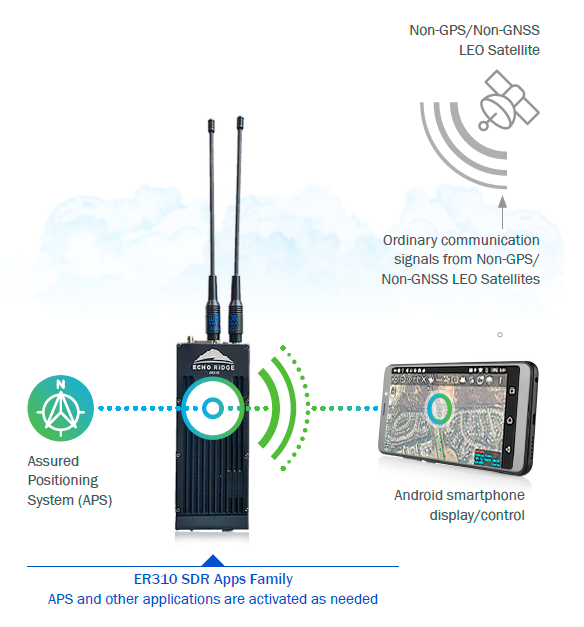
Assured Positioning System (APS™) provides positioning, navigation and timing information in environments where GPS or other GNSS is unavailable or unreliable. APS derives location information from ordinary communications signals transmitted from low-Earth-orbit (LEO) satellites. These signals-of-opportunity (SoOP) are not special position/navigation signals and are not subject to GPS/GNSS jamming or spoofing. For dismount applications, SoOP technology can be combined with IMU and barometric sensor inputs. In addition, APS is provided as a plug-in to the Android Team Awareness Kit (ATAK) residing on a user smartphone.
What is Assured Positioning, Navigation and Timing (PNT)?
Assured positioning, navigation and timing is a broad phrase that implies GPS is unreliable and uses other technologies to provide position, navigation and timing data.
PNT: Positioned For Accuracy
- Independent backup and/or complement to GPS/GNSS
- Unaffected by GPS/GNSS jamming and spoofing
- Leverages Non-GPS/GNSS satellite signals of opportunity
- Military and commercial applications
- Dismount, mounted, guidance
- Hosted application for ER310 SDR™; our multi-mission handheld software defined radio
Integrated Sensing From Multiple Inputs
Non-GNSS Satellite Communications Signals
- LEO commercial satellite communications transmissions
Terrestrial Signals of Opportunity (SoOP)
- Commercial broadcasting
- Mobile networks
- Sources are unaffected by GPS/GNSS jamming & spoofing
NavWeather
- Provides spectrum sensing and alarms on interference or jamming
IMU & Barometric Sensors
From Our Experts: How Assured Positioning System Could Help Avoid Threats to GPS Receivers
Where Can APS Be Deployed?
Peanut Software-Defined Radio™
Parsons’ Peanut Software-Defined Radio (SDR) family of systems (FOS) combines high performance, versatility, and value in a space-efficient package that can host a wide range of demanding military and commercial RF applications. Peanut SDR™ platforms are designed to support an extensive range of use cases, including but not limited to alternative/assured PNT, RF situational awareness (SA), tactical edge applications, and complementary precision timing, to name a few. Peanut SDRs are available as an OEM circuit card or in low-SWaP-C enclosures and are equipped with processing power and I/O capability required to implement complex DoD and commercial applications and RF tasks.
Peanut-D (Dismount) Key Features
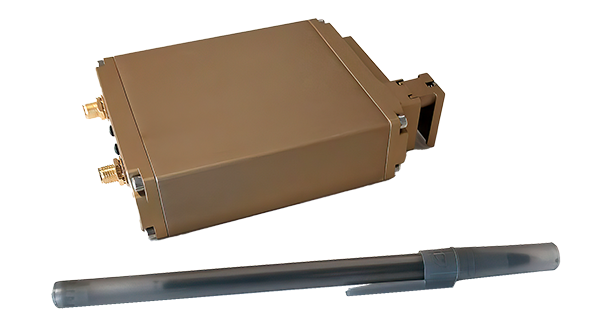
- High-performance, very-low-SWaP-C SDR
- Body-wearable solutions
- Expendable devices
- Supports challenging RF applications and missions
- GPS-denied PNT
- RF situational awareness
- Tactical edge applications
- Size and power
- 3” x 4” x 1” enclosure (also available without
enclosure) - 8 oz.
- 2W average power via USB 2.0 (+5v DC)
- 3” x 4” x 1” enclosure (also available without
- I/O
- 1 Rx port, (325–3800 MHz), +3v DC-biased, SMA-female
- 2x USB 2.0, ethernet (via ext. adapter)
- IMU, barometer, real-time clock
Peanut-M (Mounted) Key Features
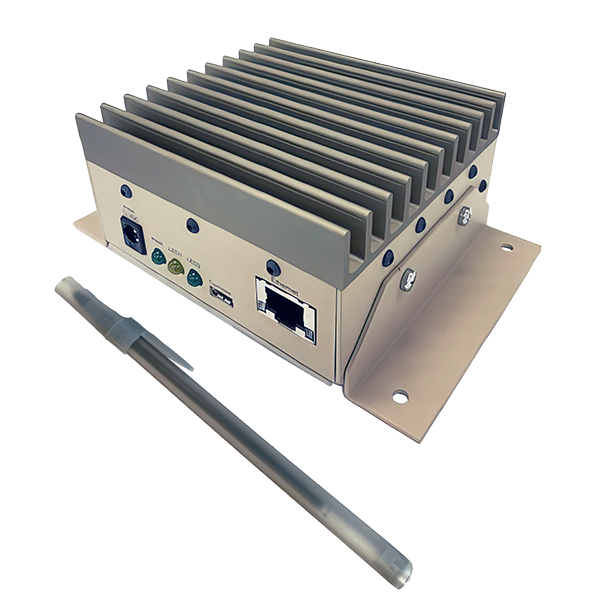
- High-performance, low-SWaP-C SDR
- Small UAS deployment
- Mounted platforms
- Supports challenging RF applications and missions
- GPS-denied PNT
- RF situational awareness and EW
- Tactical edge applications
- Precision timing backup
- Capacity to accommodate additional signal processing
- Size and power
- 3.5” x 4” x 2” (also available without enclosure)
- 14 oz.
- 6W average power via barrel plug (+8–20v DC)
- I/O
- 2Rx, 2Tx, (70–6000 MHz), SMA-female,
+3v DC-biased Rx - 10MHz and 1 PPS (in/out)
- USB console port
- Gigabit ethernet
- 2Rx, 2Tx, (70–6000 MHz), SMA-female,
- IMU, barometer, real-time clock
Peanut’s architecture dramatically minimizes the development cycle of even the most complex signal processing algorithms by reducing FPGA programming requirements and relying instead on accelerated general purpose multi-core ARM processors.
Peanut provides the processing power and I/O support required for complex RF tasks such as the following:
- Alternate PNT (non-GPS/GNSS)
- RF situational awareness
- RF emitter geolocation/tracking
- Tactical edge applications
- Passive communications receiver
- Precision timing backup for electrical grids, financial and comms networks, etc.
ER310 Software-Defined Radio
In addition, APS can be implemented on ER310. ER310 is our flexible, high-performance, handheld platform designed to host and execute challenging RF applications with demanding real-time processing and communications requirements. ER310 supports a wide scope of missions, including assured PNT (Positioning, Navigation and Timing).
*Parsons complies with all applicable Trade Compliance regulations. Some of Parsons products may require an authorization from the U.S. Government before they are exported.
Related Products
WISP™ ↗
The Wireless Instrumented Streaming Platform (WISP) is a portable, remotely controlled wideband RF data capture and analysis tool.
TEMS™ ↗
Tactical Edge Electro-Magnetic Sensor (TEMS™) is a real time, situational awareness plugin for Android Team Awareness Kit (ATAK).
DYSE® ↗
The Dynamic Spectrum Environment Emulator (DYSE®) is a test asset that emulates realistic RF environments.