Estimated reading time: 5 minutes
Key Takeaways
- The Kicking Horse Canyon Phase 4 Project upgraded a narrow, hazardous road to a modern four-lane highway, enhancing the Trans-Canada Highway.
- Innovative design tackled steep terrain and natural hazards by focusing on stability and safety while minimizing excavation costs.
- Phased construction strategies kept traffic flowing without full-scale closures, enabling extensive earthworks and rock blasting.
Transforming A Critical Corridor In One Of Canada’s Most Complex Landscapes
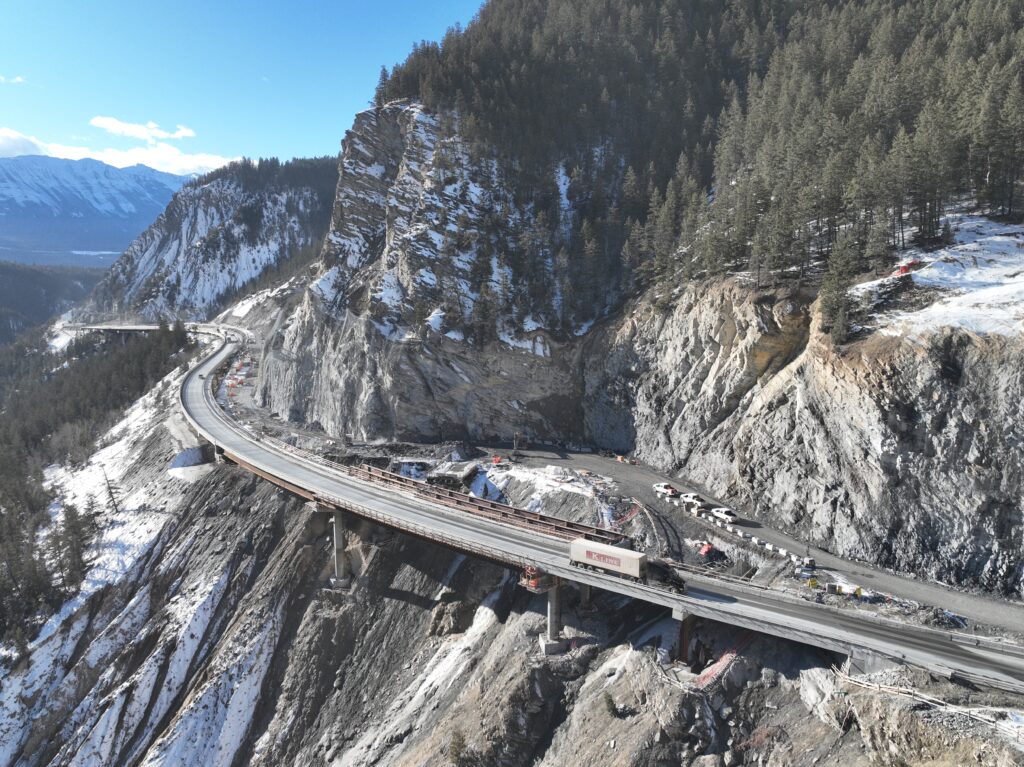
The Kicking Horse Canyon Phase 4 Project represents the final and most technically demanding stage of construction through this rugged corridor. This phase was the definitive step in upgrading the canyon’s capacity, transforming a winding two-lane road into a modern 100 km/h four-lane divided highway and completing the final section of the Trans-Canada Highway through the canyon. As Canada’s primary east-west link, this highway is vital for both passenger and commercial freight.
However, its original narrow configuration and exposure to natural hazards made it one of the most challenging sections of highway in the Canadian Rockies. To resolve these long-standing issues, this phase of the project realigned approximately 5 km (3 miles) of roadway to meet modern standards, which required managing some of North America’s steepest and most geotechnically complex terrain while maintaining traffic flow on a route where no viable alternate detours exist.
Constructability-Focused Design In Extreme Terrain
The canyon environment presented a combination of challenges rarely encountered on a single project. Steep mountain slopes, highly variable subsurface conditions, retrogressive slope failures, and hazards such as rockfall, debris flow, and avalanche loading required innovative design approaches and proactive avoidance strategies. Because of these conditions, our team carefully balanced stability, safety, and constructability, ensuring that rock and soil excavation were managed and minimized wherever possible.
To achieve this, our designers worked closely with the construction joint venture, including Parsons Construction Group, to design not only for the final condition but for every incremental step required to achieve it. This collaboration resulted in innovative implementation of phased construction, temporary works, and erection sequences that minimized costs and streamlined the schedule.
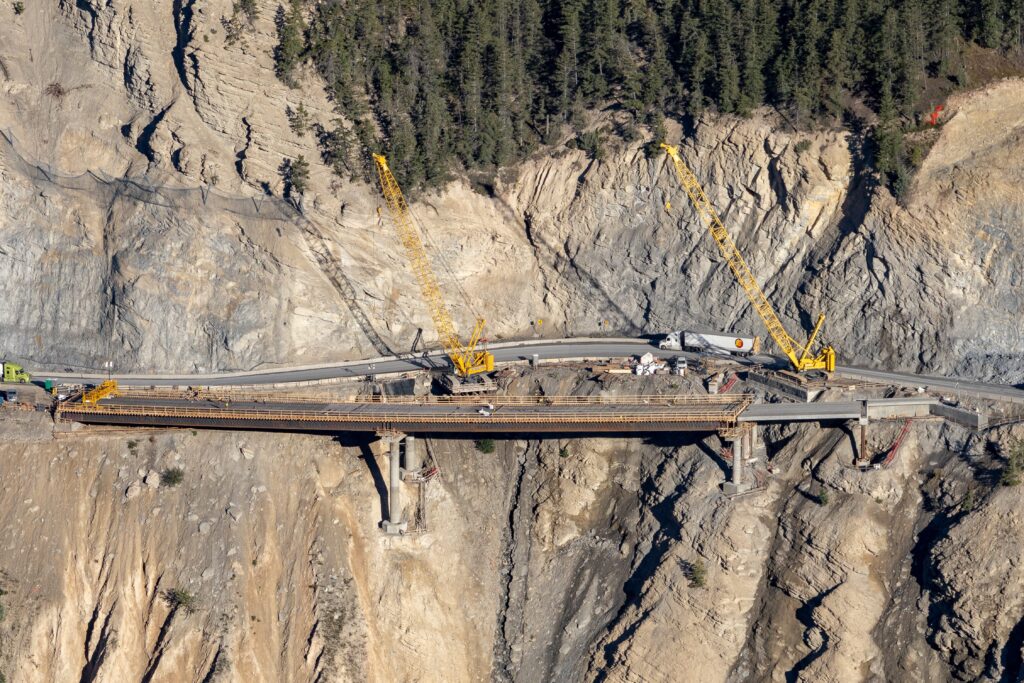
These efficiencies were realized through strategic adjustments to the structures. For instance, foundations were designed to follow the natural contours of the mountainside rather than the rigid layout of the superstructure, which significantly reduced the need for excavation. Skewed but parallel bents were utilized to allow for the lateral slide of curved steel plate girder pairs. Unique notched splice plate details allowed for easier and faster steel girder erection. Lean-on bracing cross-frames were utilized in the girder bay between girder erection phases to allow for a more flexible behavior to mitigate differential deflections and reduce locked-in stresses.
Shifting the location of bridge piers, strategic additional excavation under bridges, and upslope catchment basins helped divert 300-year event avalanche, rockfall, and debris flow loads unique to the canyon away from critical roadway surface and bridge substructures. Providing responsive re-designs after unknown geotechnical conditions were discovered during construction.
These seemingly small but impactful changes were identified early through collaboration, causing no delays in the design phase and greatly improving construction speed. Ultimately, this focus on constructability allowed the project to be delivered on time and on budget despite the extreme environment.
Constructing Without Stopping Using Phased Execution
Because the canyon lacks viable detours, maintaining the flow of the Trans-Canada Highway was a non-negotiable constraint that dictated the entire construction sequence. We utilized a coordinated phased construction strategy to manage the work effectively within the corridor. Traffic was first shifted onto the newly completed Phase 1 portion of the bridge structures, which served as a temporary bypass.
This shift provided a vital safety buffer, allowing the team to perform extensive rock blasting and heavy excavation on the adjacent hillside without endangering motorists. Once the mountain was carved back to accommodate the new alignment, we proceeded with the construction of the final phase of the structures. This sequence was essential to minimizing full-scale closures while enabling the massive earthworks required to widen the corridor.
A Safer Corridor And A Model For Complex Infrastructure Delivery
The Kicking Horse Canyon Phase 4 Project demonstrates how innovation and collaboration can overcome even the most formidable engineering challenges. By integrating advanced foundation design, adaptive bridge solutions, and highly coordinated construction strategies, Parsons successfully delivered a transformative upgrade within an area characterized by complex environments.
The result is a safer, more reliable section of highway that will support regional mobility and economic activity for decades to come. Just as importantly, the project establishes a framework of proven techniques and lessons learned, offering a valuable blueprint for future infrastructure projects in mountainous and geotechnically complex terrain.