Jubail Island Development – Abu Dhabi, United Arabi Emirates
Client

- Jubail Island Investment Company (JIIC)
Project Value 
$235 Million USD
Market

Urban Development
Services

Engineering, Program/Construction Management (PM/CM)
Jubail Island brings sustainable urban living to Abu Dhabi. The 4 million sqm LEAD development places six low-rise village communities, with capacity for 7,235 residents, within a natural reserve setting, connecting residents and visitors to nature, leisure, hospitality, and high-quality public spaces.
Parsons’ role focused on the infrastructure required to bring this vision to life. We supported utilities, roads, bridges, marine works, landscape architecture, and stormwater drainage, alongside master plan assessment, concept design for the island, detailed design for the infrastructure, stakeholder approvals, tender documentation, and construction supervision.
Our scope included:
- Master Planning
- Marina and Coastal Design
- Utility Design
- Landscape Design
- Tender Documents
- Stakeholder Approvals
- Construction Supervision
Climate Resilient Urban Development
The infrastructure strategy supported major coastal development while respecting the site’s nature reserve setting. Across an island shaped by mangroves, rock formations, coastline, and wetlands, there were multiple critical factors that had to be considered.
Marine Works
We reviewed hydrodynamic numerical modeling to assess:
- Flushing rates
- Development impacts on flow patterns
- Marine ecology
- Wave agitation inside the marina
The Outcome?
- 8 kilometers of non-navigable flushing channels
- 335 meters of quay wall
- A slipway system
- 536-meter swimming beach, boardwalks, and kayak stations
The marine works improve public access, recreation, and nature connectivity through beaches, marinas, waterfront promenades, boardwalks, coastal protection, swimming and non-swimming beaches, and public water access at Jubail Point. Several kilometers of boardwalk are also planned through the mangrove areas.
Stormwater Resilience:
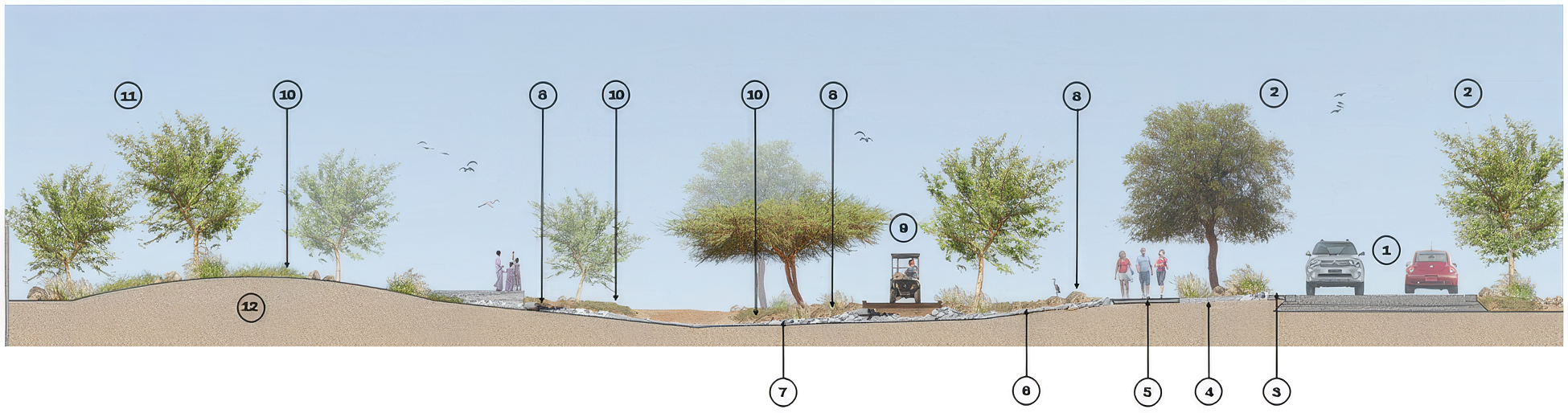
Instead of a conventional underground drainage network, Parsons developed a hybrid surface drainage approach combining:
- Optimized road grading
- Landscaped swales
- Limited positive drainage
The strategy uses the site’s natural topography to reduce underground works, improve climate resilience, and direct runoff to landscaped wadis.
The Outcome?
- Reduced underground infrastructure to approximately 7.8 kilometers of positive drainage network
- 234 landscaped swales providing around 95,000 square meters of stormwater storage.
- The system was designed for the 1-in-5-year storm event, verified for the 1-in-10-year event, and offers capacity up to the 1-in-25-year event, strengthening future climate readiness
Landscape:
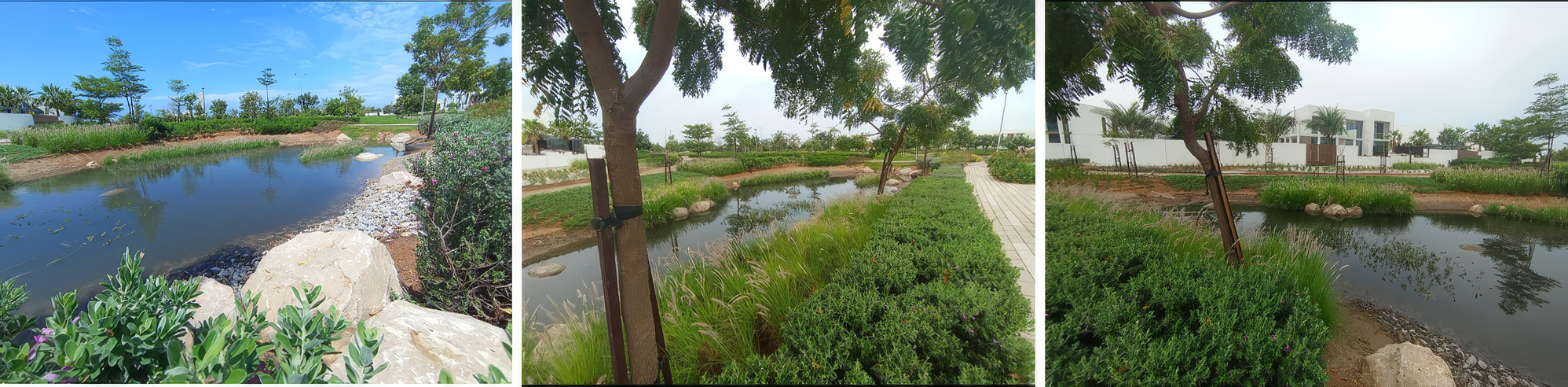
The hybrid surface drainage approach allows stormwater infrastructure to double as landscaped scenery. Landscaped wadis store runoff temporarily while enhancing public spaces, biodiversity, and year-round visual quality. By combining optimized road grading with limited positive drainage, the strategy maximizes gravity driven drainage by reducing:
- Underground works
- Utility conflicts
- Long-term maintenance
Validated by stakeholders and Parsons’ in-house specialists, the system proved effective during heavy rainfall in the UAE. It demonstrates a passive drainage model that integrates flood protection, landscape architecture, environmental value, and community experience.
Retaining stormwater on site supports irrigation, reduces marine runoff, enhances biodiversity, supports urban cooling, and lowers lifecycle costs.
Safety as a Core Value
Jubail Island Investment Company recognized the project for Outstanding Performance on Health, Safety, and Environment and for completing 2.8 million manhours without Lost Time Injury. Together, the marine works, hybrid stormwater strategy, utilities, landscape integration, approvals, and construction supervision show Parsons’ ability to deliver future-ready infrastructure with lasting community value.

