Highway 401 Expansion — Ontario, Canada
Client

- Infrastructure Ontario, The Ministry of Transportation Ontario
Project Value 
$639.8 Million
Market

Transportation
Services

Alternative Project Delivery, Design, Engineering
The successful completion of the Highway 401 Expansion Project – Mississauga to Milton, also known as the “hot lanes”, stands as a transformative achievement in Ontario’s transportation history. This multi-lane expansion project included multiple transportation complexities executed over a three-year schedule that continues to provide exceptional value for the public long after construction completed. The project not only improved safety and traffic flow for millions of drivers but also strengthened regional connectivity, reduced congestion, and supported long-term economic growth across the Greater Toronto Area.
Transforming North America’s Corridors Through P3 Innovation
This project represents a benchmark in P3 (Public-Private Partnership) design and construction excellence. Delivered through a fully integrated joint venture between Aecon, Parsons, and Amico, the project widened and reconstructed 18 km of one of North America’s busiest corridors—all while maintaining full traffic flow and meeting an aggressive delivery schedule during the COVID-19 pandemic.
Parsons served as both a Design-Build Joint Venture (DBJV) partner and the lead design engineer, ensuring seamless integration between design and construction processes. This alignment fostered efficient decision-making, encouraged innovation, and removed traditional contractual barriers between design and construction teams.
Scope Of The Project
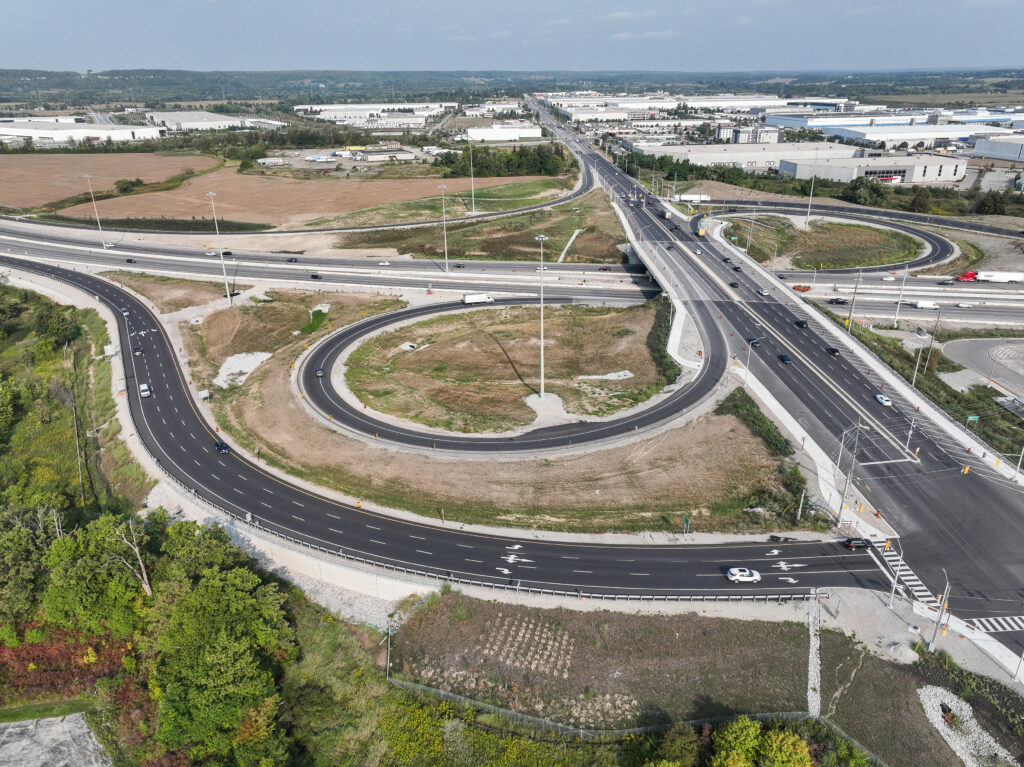
The JV delivered the full scope of the project that included a complex 18-kilometre reconstruction and widening of Highway 401 west of the Greater Toronto Area, from east of the Credit River in Mississauga to west of Regional Road 25 in Milton. In addition to widening the existing six-lane configuration to 10 and 12 lanes in key congestion areas, the work also included the reconstruction of bridges, upgrades to support facilities and features, construction of carpool lots, the coordination of complex staging, and major traffic management and accommodations. In detail, the construction included:
- Construction of a 12-lane core-collector system from the Credit River to Winston Churchill Blvd.;
- Construction of 10 lanes from Winston Churchill Blvd. to Highway 407 ETR and Highway 401 interchange;
- Construction of a 12-lane core-collector system from Highway 407 ETR and Highway 401 interchange to James Snow Parkway;
- Construction of 10 lanes from James Snow Parkway to RR 25;
- Construction of nine new, replaced or widened bridges and five bridge rehabilitations; and
- New or improved support facilities and features, such as drainage, lighting, signage and carpool lots.
Construction commenced in 2019 and West Corridor Constructors project team executed all major scopes of work including the excavation and grading, drainage, structures, electrical and lighting, asphalt paving, environmental controls, and traffic management. Key quantity metrics were recorded over the span of three-year schedule, showcasing the impressive amount of installation, construction, and fortification that was required for the project. The most notable stats include:
- 11 tub girders (under passes)
- 115 girders (over passes)
- 8 structures of steel girders
- 60,522 metres of permanent barrier walls and transitions
- 67,564 cubic metres of concrete
- 3,250 metric tonnes of rebar
- 134 high-mast light fixtures
Highway 401 Expansion: Prioritizing Environmental Stewardship
The Highway 401 Expansion project carefully addressed environmental impacts on ecosystems, woodlands, and wildlife areas along the 18-km corridor. The team implemented wildlife crossings, erected 30 bat nesting structures and two bird kiosks, and installed 32,000 meters of highway fencing and 5,400 meters of wildlife fencing. Landscaping efforts included planting 12,890 native trees and shrubs to restore natural habitats. Sustainability was also a key focus, with 650,000 metric tonnes of granular material and 750,000 metric tonnes of asphalt recycled and repurposed over three years, enhancing the project’s environmental performance.
Why The Highway 401 Expansion Is Critical To The Ontario Region

Highway 401 is a significant controlled-access 400-series highway in the Canadian province of Ontario that stretches 828 kilometres from Windsor in the west to the Ontario–Quebec border in the east. The 401, also known as the Macdonald-Cartier Freeway, is not only North America’s widest highway, but it’s also the busiest—a 2019 analysis stated that the annual average daily traffic count for the section of Highway 401 that passes through Toronto can reach over 500,000 vehicles on some days. As a key commuter and economic corridor, only the most influential and crucial Highway 401 expansion or rehabilitation projects would be approved by the Ministry of Transportation Ontario (MTO).
From this perspective, the Highway 401 Expansion Project – Mississauga to Milton was designed to have a positive impact on the traffic community and the province’s environmental footprint, while also providing significant economic benefits that stimulates long-term growth and development in the region.
Selecting The P3 (Public-Private Partnership) Model


One of the project goals was for it to be completed within a very short timeframe, considering the size and scope of the project. This schedule could only be achieved under a Design-Build delivery model, which allowed for an accelerated design schedule to allow for early works and construction planning/mobilization to begin. Once the Design Build Model was confirmed, MTO and IO worked together to assess whether the Traditional MTO DB or a P3 would be better suited for the project. Based on the size of the project and the value for money assessment, the P3 Model was selected.

