Understanding The Role Of The Program Delivery Partner (PDP)

Estimated reading time: 3 minutes
Globally, major infrastructure programs are growing in scale and complexity. This presents even more challenges for clients to create value over the long term. Traditional contract forms and delivery methods have struggled to keep pace with the growing demands of clients. This has led to delays, cost overruns and disputes.
The Program Delivery Partner (PDP) approach, being developed by market leaders in program management, including Parsons, aims to meet these evolving client needs. It focuses on the value of outcomes, which may include time, cost, quality, and broader public or economic goals.
Key Program Criteria
The applicability of PDP models and approaches in practical examples seems to be highly related to certain program characteristics. These focus around six key criteria listed below. Each criterion results in consequential impacts, often in the most challenging delivery environments, with multi-staged requirements over a protracted period. Partnering effectively in these environments by choosing the right program delivery partner becomes essential.
The criteria are:
- High financial value
- Long duration
- Technical complexity
- High-risk profile
- Key non-negotiable milestones
- Specialized requirements
Similarly, successful implementations focused upon principles of trust, transparency, and collaboration. These principles are essential for establishing an effective program management environment and require concerted effort from all parties involved. This approach emphasizes the development of a shared culture, an aligned commercial model, and an optimized organizational structure.
Further Research And Development
It is clear there is a growing requirement for PDP approaches and models. This is needed to tackle the rising size, number, and complexity of global projects and programs. However, it also appears that traditional program management and commercial frameworks are often seen as constraining rather than enabling the evolution of the PDP. There is a noticeable absence of an established body of knowledge for this type of organizational arrangement. This includes partnering with an effective program delivery partner.
To address this issue, Parsons and University College London (UCL) have agreed to engage in an exploratory study. This will focus on knowledge co-creation through the method of Engaged Scholarship (ES). ES operates on four key premises:
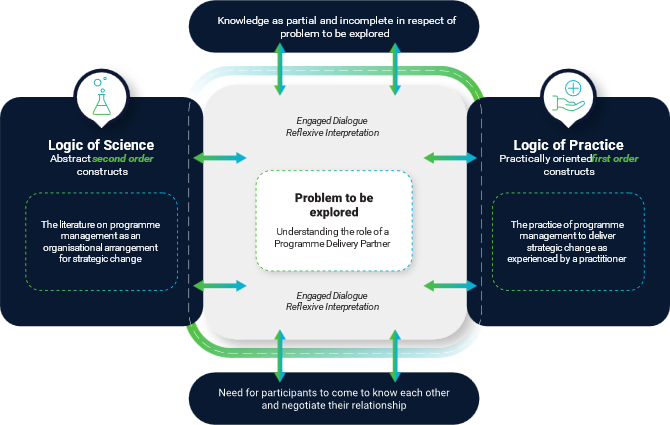
- Research and practice are distinct logics of knowledge,
- Each party has partial knowledge,
- Relationships are negotiated and mutually beneficial; and
- Findings are interpreted reflexively.
The initial findings, including the problem statement and emerging themes, are explored in more detail. They are accessible in the free to access UCL portal.