Cleaning AFFF From A Major International Airport Firefighting Vehicle — United States
Client

- West Coast International Airport, United States
Project Value 
N/A
Market

Aviation, Energy And Environment, Water And Wastewater
Services

Sustainability
In July 2022, TRS Group, Inc. (TRS), a Parsons company, with EFI Global, Inc. (EFI), performed a clean-out of aqueous film forming foam (AFFF) on a Pierce aircraft rescue and firefighting (ARFF) vehicle at a major West Coast airport. AFFF contains per- and polyfluoroalkyl substances (PFAS). These compounds can persist for centuries and have adverse effects on human health and the environment. The goal of the clean-out was to remove the contamination, specifically perfluorooctanoic acid (PFOA) and perfluorooctane sulfonate (PFOS). TRS aimed to clean the ARFF’s AFFF storage tank and dispersion network to the extent practicable.
As the airport wanted to discharge the rinsate to its water treatment system, the airport authority required the PFOA and PFOS concentrations to be below 2 nanograms per liter (ng/L). Further, TRS evaluated concentrations three days later. This was done to assess rebound in the storage tank.
Triple Water Rinse
To compare the Department of War’s suggested triple water rinse (3x Rinse) clean-out method with TRS’s approach, TRS performed a 3x Rinse of the AFFF tank with potable water prior to initiating our process. This process uses a PerfluorAd™ solution. Following standard protocols, TRS collected a water sample after the first rinse (baseline) and after the third fill and drain of the storage tank.
PerfluorAd
PerfluorAd is a plant-based, weak oleic acid that has a strong affinity to PFAS, forming small particles (flocs) that we can easily filter.
After the 3x Rinse, TRS initiated our method for the remainder of the cleanout. This method includes circulating the PerfluorAd™ solution through the storage tank and foam dispersion network, followed with potable water. TRS completed four flushes, treated the accumulated rinsate with PerfluorAd, filtered the generated flocs, and then polished the rinsate with liquid-phase granular activated carbon (LGAC).
Results
While the 3x Rinse removed some PFOA, a fair amount remained. After applying our approach, the analytical results showed more than 99.9 percent (%) PFOA removal.
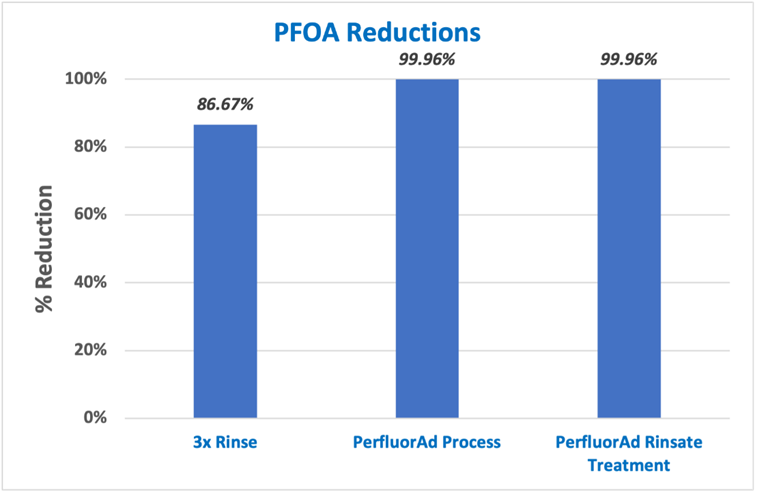
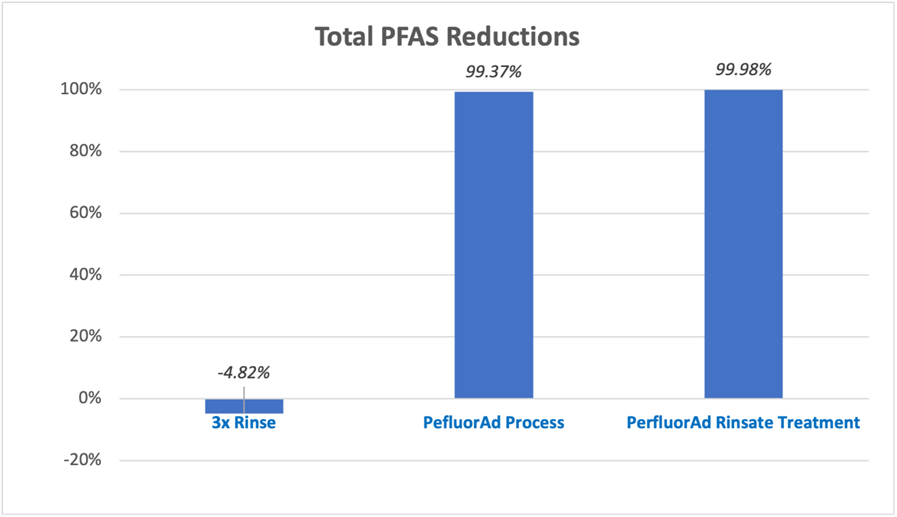
TRS achieved similar results for total PFAS, shown below in Figure 2. Baseline concentrations were greater than 60,000 ng/L. Our process resulted in reductions greater than 99% for the vehicle cleanout and rinsate. Interestingly, the 3x Rinse resulted in total PFAS concentrations increasing.
As mentioned above, the scope of work included a rebound test, which entailed returning to the vehicle after it was inactive for more than 48 hours. TRS established a potable water recirculation loop between the firefighting vehicle AFFF tank and a new, unused 300-gallon polyethylene tank. TRS recirculated the water between the two tanks at about 4 gallons per minute (gpm) for 150 minutes. Thereafter, TRS collected a water sample from the loop. Rebound results were non-detect for PFOA and PFOS.
TRS treated all the generated rinsate with PerfluorAd. Final PFOS and PFOA rinsate concentrations were non-detect, which, of course, were under the clean-up criteria of 2 ng/L.
Request AFFF Cleanout Services
We provide AFFF cleanout services for fixed and mobile systems. Click below to request services:
