Estimated reading time: 5 minutes
Major urban transit projects are no longer judged solely on how efficiently they move people. Increasingly, they are also expected to strengthen community resilience, protect municipal infrastructure, and respond to the realities of climate change. The Edmonton Valley Line West LRT project offers a clear example of how thoughtful stormwater management can deliver these outcomes, even within tight urban constraints.
The Valley Line West is a 14-kilometre, at-grade light rail extension connecting downtown Edmonton to Lewis Farms. Delivered as a design-build project, it includes 14 street-level stops, 2 elevated stations, new guideways, roadway improvements, utility relocations, and expanded maintenance and storage facilities. Like many Canadian cities, Edmonton faced a familiar challenge: how to manage additional stormwater runoff from new infrastructure in a fully urbanized corridor with limited space and dense underground utilities.
Rethinking Traditional Stormwater Solutions
Conventional stormwater management solutions, such as large ponds or underground storage tanks, were not feasible along much of the corridor. Construction limits, traffic demands, and competing utility corridors left little room for traditional approaches. Instead, the project team explored Low Impact Development (LID) strategies that could be integrated directly into streetscapes.
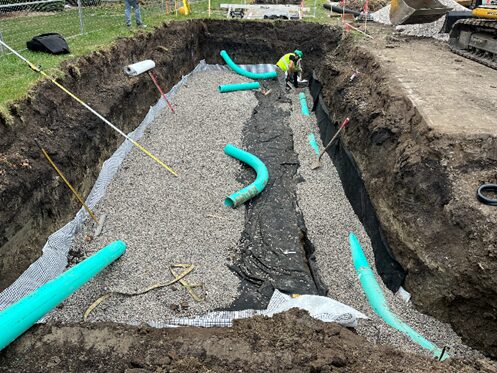
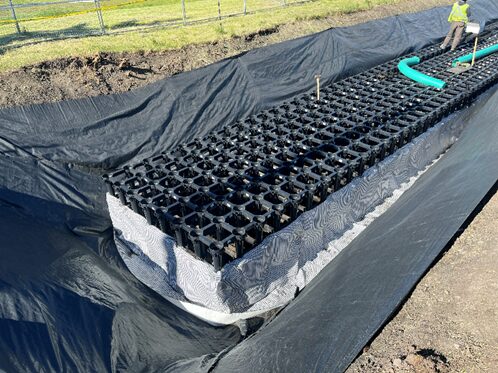
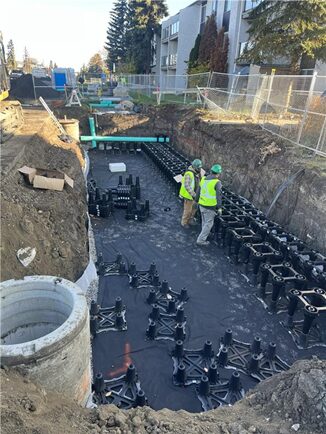
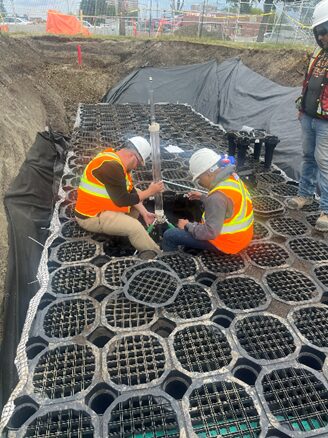
Linear retention and detention systems, including soil cell installations beneath sidewalks and landscaped areas, emerged as the preferred solution. These systems were designed to temporarily detain store stormwater runoff, promote infiltration, and slowly release excess flows to the municipal sewer system without overloading the existing sewer system.
Balancing Engineering, Constructability, And Operations
One of the key lessons from the project was the importance of early and continuous collaboration. Drainage, roadway, landscaping, and utility teams worked closely together and with the City of Edmonton to ensure solutions were not only technically sound but also constructible and maintainable.
City criteria allowed some flexibility, recognizing the challenges of urban construction. As long as post-development peak flows did not exceed defined thresholds above existing conditions, uncontrolled discharge to the municipal system was permitted. LID features were therefore targeted to locations where controls were most needed, rather than applied uniformly along the corridor.
This targeted approach reduced risk, optimized costs, and allowed construction to proceed efficiently, a critical consideration on a design-build project with overlapping design and construction timelines.
Community And Climate Benefits
Beyond meeting regulatory requirements, the integrated LID approach delivered tangible community benefits. Soil cell systems support healthy street trees, which provide shade, improve air quality, and reduce urban heat during summer months. Increased infiltration and evapotranspiration help moderate runoff volumes and improve water quality before discharge.
While climate change adaptation was not the primary driver of the project, the outcome supports long-term resilience. The stormwater system was designed to manage both frequent storm events and larger, less frequent storms, reducing localized flooding risks along key intersections and transit corridors
Lessons For Future Urban Infrastructure
Several clear lessons emerged from the Valley Line West experience:
- Plan for stormwater early. Identifying stormwater needs at the outset allows right-of-way space to be allocated before utilities and road geometry are finalized.
- Integrate disciplines. Stormwater, landscaping, and roadway design work best when treated as a single system, not separate silos.
- Engage owners and operators. Early discussions with municipal operations teams build confidence in LID performance, maintenance, and winter operations.
- Be flexible, but focused. Applying controls where they provide the most benefit can be more effective than rigid, corridor-wide solutions.
As Canadian cities continue to expand transit networks within constrained urban environments, projects like Edmonton’s Valley Line West demonstrate that innovative, integrated stormwater management is not only possible, but essential. By aligning engineering solutions with community and environmental goals, infrastructure can deliver lasting value well beyond its primary function
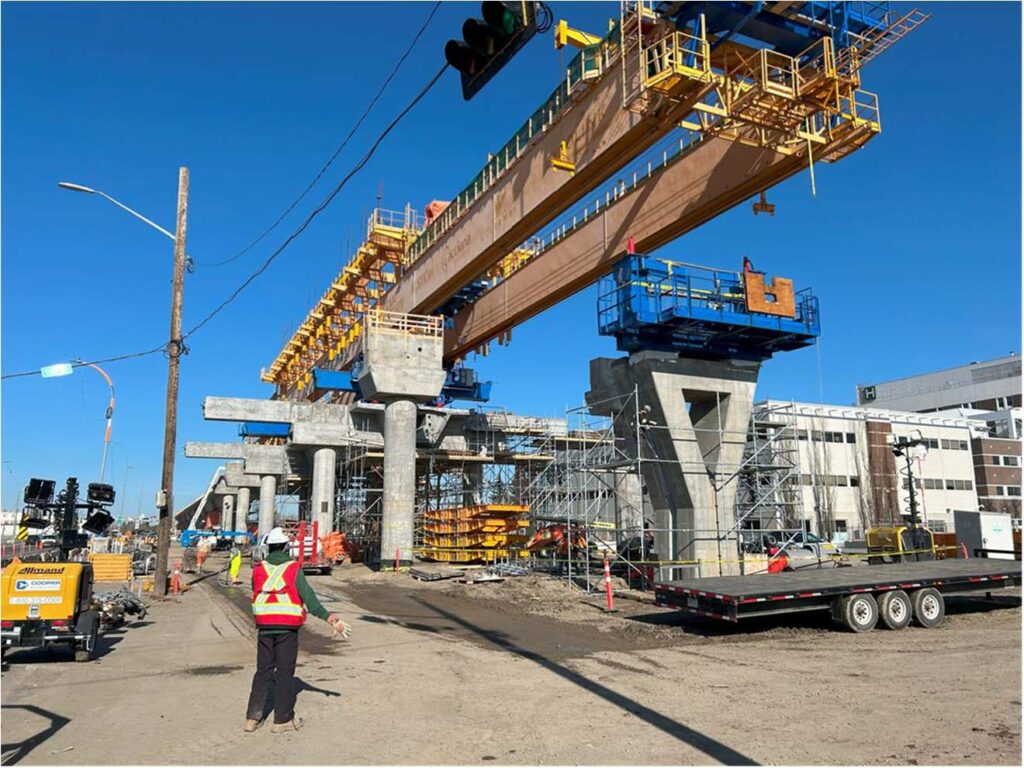
Elevated Guideway
Soil-Cell Installation