Cost-Effective Construction Solutions For Aging Networks Amid Fiscal Constraints: The Hull Causeway Widening Project
Estimated reading time: 5 minutes
Aging infrastructure, limited funding, and growing demands for safer mobility are challenges faced by many cities across Canada. The widening of the Hull Causeway, one of eight structures making up the Chaudière Crossing between Ottawa, Ontario, and Gatineau, Québec, shows how thoughtful engineering and innovative design can address all three, while delivering meaningful benefits to the local community.
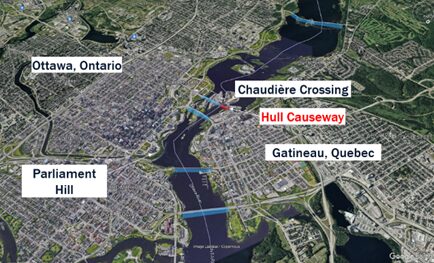
The Chaudière Crossing, managed by Public Services and Procurement Canada, is one of five vehicular interprovincial crossings in the National Capital Region and one of only two that carry truck traffic. It plays a critical role in connecting the downtown cores of Ottawa and Gatineau and supporting daily commuting, commercial movement, and regional tourism. Originally built in the 1950s, the bridge carried two traffic lanes and a pedestrian walkway but lacked dedicated cycling facilities. Cyclists were forced to either mix with vehicle traffic or use the pedestrian space, creating safety concerns for everyone using the bridge.
The Need For A Better Solution
The initial concept for improving active transportation involved widening the bridge slightly and constructing a separate cycling structure alongside it. While this met functional requirements on paper, it introduced significant cost, complexity, and constructability challenges. The biggest issue lay beneath the bridge: a large and complex geological feature known as the Devil’s Hole.
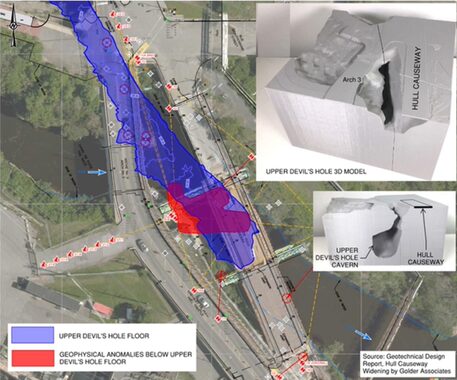
The Devil’s Hole is a karst formation—an underground network of voids and cavities formed by erosion of the bedrock over time. Extensive investigations, including sonar surveys, drilling, and geotechnical modeling, revealed that these voids extended beneath key bridge foundations. In some areas, the bedrock supporting the structure was undercut, raising concerns about long-term stability along with worker safety during construction. As a result, strict work restrictions were imposed, including no-access zones and continuous monitoring requirements. These constraints forced the project team to rethink the approach.
An Integrated And Cost-Effective Design

Instead of building a separate cycling bridge, the team developed an alternative solution that widened the existing Hull Causeway enough to accommodate all users. The final configuration includes two 3.5-metre traffic lanes, two raised 2.0-metre cycle tracks—one in each direction—and a 2.0-metre sidewalk. This eliminated the need for a new standalone structure while significantly improving safety for cyclists and pedestrians.
This integrated design reduced construction footprint, minimized environmental and geotechnical risks, and lowered overall project cost. It also simplified operations for the community by keeping all users on a single, clearly organized structure.
Innovative Foundation Solutions
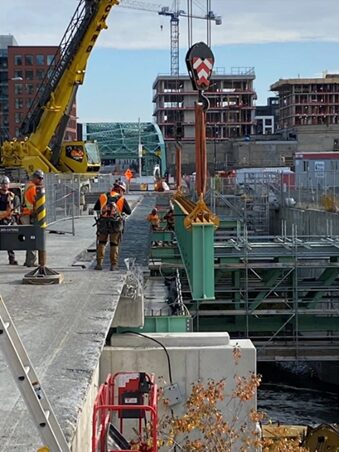
Addressing the Devil’s Hole was the most technically challenging aspect of the project. Traditional solutions, such as deep caisson foundations extending up to 50 metres into bedrock, were impractical given the restricted access, safety concerns, and high cost.
Instead, the team designed a reinforced concrete extension to the existing north abutment. This extension acts as a concrete pillar embedded in a rock pocket and anchored into the bedrock and existing structure using prestressed rock anchors and passive reinforcement dowels. This solution provided the required strength and stability without extensive excavation or heavy equipment in a restricted area.
Similar tailored solutions were applied elsewhere on the bridge. Micropiles were used at the south abutment to limit excavation. At the north approach, steel pipe piles were drilled below the influence of the Devil’s Hole, combining with rock anchors to reinforce the surrounding bedrock. The northwest pier, which showed signs of undercutting, was stabilized using inclined rock anchors and vertical dowels to secure the rock mass supporting the existing caissons.
Benefits To The Community
For the local community, the benefits of this project are immediate and long-lasting. Cyclists now have safe, dedicated space separated from vehicles and pedestrians. Pedestrians benefit from a clearer, more comfortable walkway. Drivers experience improved traffic flow on a critical interprovincial route.
Just as important, the project extends the life of a vital piece of infrastructure without major disruption to traffic or the surrounding environment. By avoiding unnecessary new structures and focusing on smart reuse and strengthening of existing assets, the project reflects responsible stewardship of public funds.
A Model For Aging Infrastructure
The Hull Causeway Widening demonstrates that innovative thinking does not always mean adding more—it often means doing more with what already exists. By combining detailed investigation, collaboration with construction partners, and adaptable design solutions, the project team transformed a complex geological challenge into an opportunity to deliver safer, more inclusive infrastructure.
As communities across Canada look to modernize aging transportation networks, this project offers a clear lesson: with the right approach, even the most difficult constraints can lead to better outcomes for the people who rely on these connections every day.