The Arrowhead Associates, Inc./Scovill Corp. Superfund Site (the Site) is in Virginia’s Northern Neck region between the Rappahannock and Potomac Rivers. Historical manufacturing activities, including degreasing and electroplating, resulted in chlorinated volatile organic compound (CVOC) and 1,4-dioxane impacts to soil and groundwater. In 2011, a company purchased the property for tactical training activities, including comprehensive anti-terrorism and force protection for United States and international militaries and law enforcement agencies. In a settlement agreement with the owner, a sub-slab depressurization system and modified heating, ventilation, and air conditioning units were installed to reduce trichloroethene (TCE) concentrations in indoor air to below regulatory standards.
Added to the National Priorities List in 1990, the Site’s early remedial actions included soil capping, soil vapor extraction, and installation of a zero-valent iron permeable reactive barrier. Despite these efforts, the United States Environmental Protection Agency (EPA) determined in its 2016 Five Year Review that the remedial actions were neither protective of human health and the environment in the short nor long term.
In 2020, EPA amended the Record of Decision (ROD), having determined that the primary groundwater contaminants, tetrachloroethene (PCE) and TCE, were most likely to pose a threat of vapor intrusion. Further, the TCE concentrations in groundwater were indicative of the presence of dense non-aqueous phase liquid (DNAPL). EPA concluded the contamination represented a continuing source to groundwater and vapor intrusion and that in situ thermal remediation (ISTR) and in situ chemical oxidation (ISCO) would be the final remedial measures for the source zone and downgradient groundwater plume, respectively.
EPA selected TRS Group, Inc. (now a Parsons company) and Jacobs Engineering (Jacobs) to implement ISTR via electrical resistance heating (ERH) in the defined 1.3-acre treatment area, which was entirely below the building. EPA, TRS and Jacobs worked with the property owner to minimize impacts of the remedial activities to the owner’s operations and to coordinate drill rig and field transformers ingress and egress, as well as delivery and placement of the thermal treatment equipment via cranes.
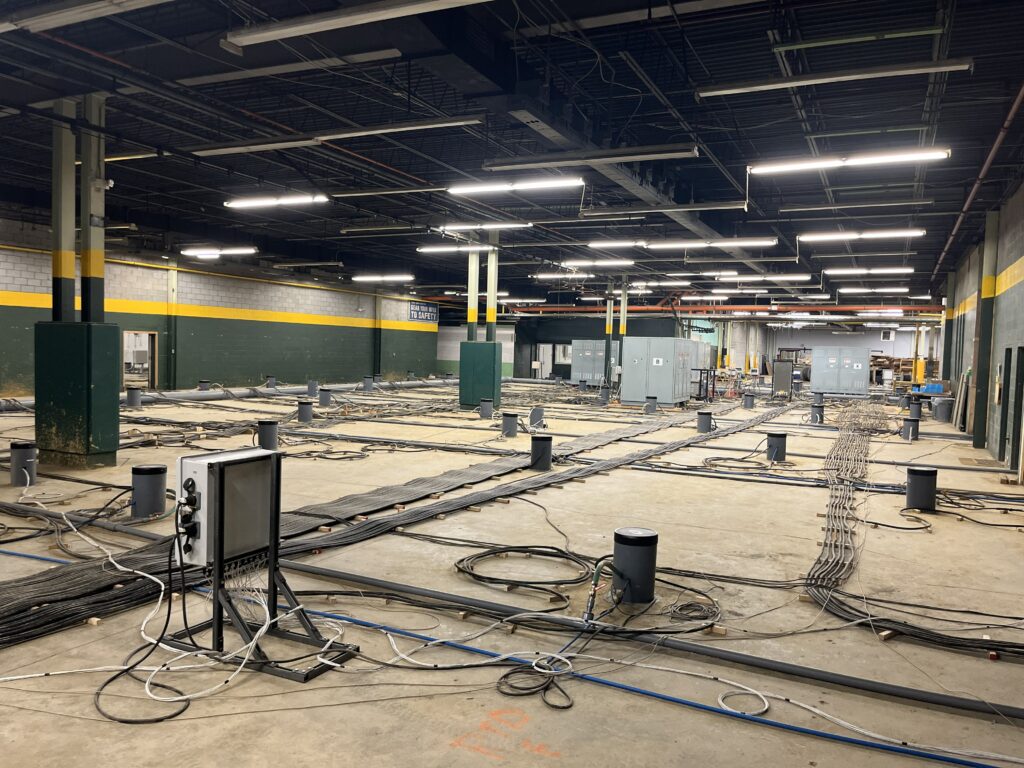
Constructing the ISTR system in the occupied building presented some unique challenges. Relocating the ammunition and weapons in rooms within the building required coordination among the property owner, TRS, Jacobs, EPA, and the US Army Corps of Engineers prior to commencing intrusive work. Additionally, the building contained obstructions, including tactical training areas, large pieces of equipment, walls, structural elements, and low ceilings. After locating subsurface utilities and surveying subsurface infrastructure locations and building features, TRS and Jacobs developed a demolition plan to allow drill rig access, removal of some training areas, removal of drop ceilings, and wall penetrations for cables and piping.
The ISTR design includes 226 dual-element electrodes, 52 temperature monitoring points, and 16 vacuum monitoring points. The ERH system conveys the extracted vapors to three condenser/cooling tower units, where TRS/Jacobs cools and condenses the vapors. Thereafter, the system conveys any remaining vapors via vacuum blowers to vapor-phase granular activated carbon vessels for treatment and pumps the condensate through liquid-phase granular activated carbon. The treatment compound is located inside a fenced area outside of the building.
Prior to ERH startup, Jacobs installed temporary fences around the perimeter of the electrode field and treatment equipment compound. We placed signs on the fences and locked and secured access doors from the inside to prevent the property owner’s employees and visitors from inadvertently entering the electrode field. We held meetings with the property owner’s employees and local emergency responders to explain the ERH remediation process, locations of emergency stop buttons, emergency access points, and notification procedures.
During startup, our personnel conducted voltage safety testing within the electrode field and outside of the treatment area where workers and visitors had access. Where we identified voltages exceeding our internal voltage limits, which are lower than OSHA standards, we mitigated the voltage risk by application of a surface coating, installation of grounding grids, or placement of rubber mats.
TRS has operated the ERH system since September 2025 and has input 70 percent of the design energy. Using a photoionization detector (PID) to measure the concentration of the vapors prior to treatment, TRS estimates removing 3,340 pounds of CVOCs from the subsurface. Collecting vapor samples for laboratory analysis and monthly groundwater samples, Jacobs has verified a declining trend in CVOC concentrations.
Defining success is an integral part of a thermal remediation solution. Meeting weekly, TRS, Jacobs, EPA, Virginia Department of Environmental Quality, and EPA’s oversight contractor review data with respect to the multiple lines of evidence approach to achieving the remedial goals. Indicators used to determine when to terminate heating include subsurface temperatures, asymptotic mass removal, energy input, and declining concentrations of PCE, TCE, and 1,4-dioxane in groundwater. The team expects to complete the project in the first few months of 2026.