Cleaning AFFF-impacted Fire Suppression Systems: Triple Water Rinse Versus PerfluorAd
Estimated reading time: 3 minutes
Aqueous film forming foam (AFFF) formulations, used for rapidly extinguishing fuel and oil fires, contain up to 6% per- and polyfluoroalkyl substances (PFAS). As state and federal agencies are limiting the allowable PFAS concentrations in the environment, the firefighting community is about to undergo the massive process of AFFF removal from firefighting systems (mobile and fixed) and replacing them with fluorine free foams (FFF). This effort will not only include draining AFFF from these systems but will also involve cleaning their wetted surfaces.
Unfortunately, PFAS form coatings that are resistant to removal and do not dissolve readily in water. Multiple studies have shown that simple rinsing with water leaves large quantities of PFAS behind (Lang et al. 2022).
Fortunately, PerfluorAd, a plant-based, weak acid, can remove PFAS far more efficiently than water.
Triple Rinse Versus PerfluorAd
The steps of AFFF removal and cleanout follow:
- Removal of AFFF concentrate
- Physical rinsing of foam tanks, pipes, and venturies
- Rinsing of the wetted surfaces using a suitable liquid
- Treatment or disposal of the rinsate and other generated waste
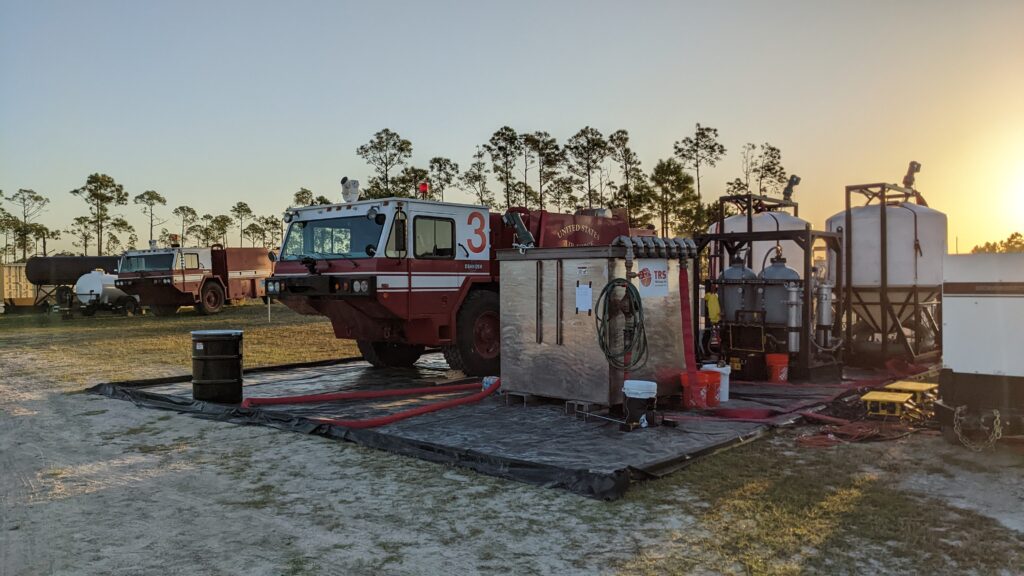
We recently compared the effectiveness of triple-rinse (three rinses of the AFFF tank using potable water only) to rinsing with a PerfluorAd™ solution. We cleaned a firefighting vehicle at a major international airport using established triple-rinse methodology. Then, we treated the same vehicle using a heated PerfluorAd™ solution with flushing and agitation, rinsing the vehicle’s internal surfaces, much like the action inside a dishwasher.
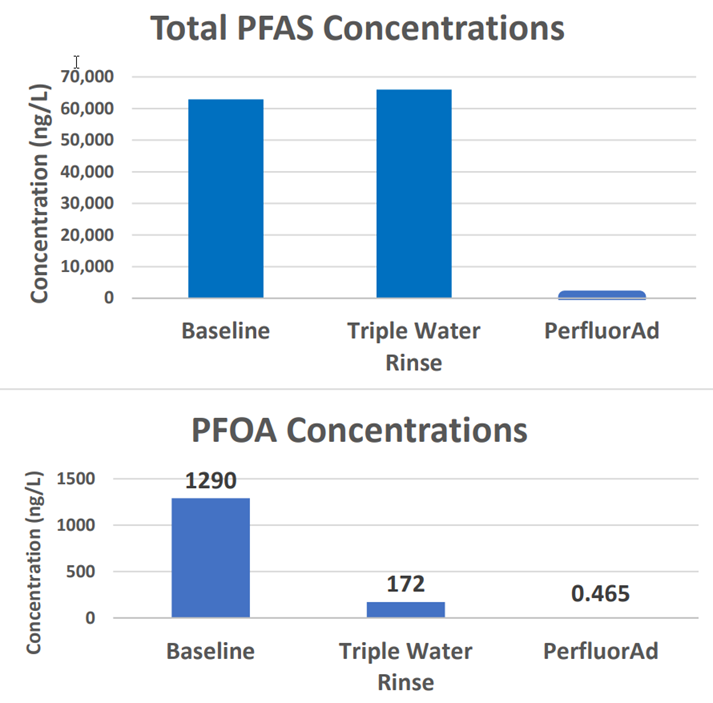
After each cleaning, we filled the foam tank with water, circulated it throughout the system, let it equilibrate, and then took samples, analyzing for specific PFAS compounds.

Note that the triple-rinse reduced the concentration of several PFAS compounds, such as PFOA, in the vehicle’s AFFF storage tank; however, there was no reduction in total PFAS concentrations. The dominant compound in the triple-rinsed water was 6:2 fluorotelomer sulfonic acid (6:2 FTS), which actually increased after rinsing with water. In contrast, PerfluorAd™ flushing resulted in a reduction of greater than 99 percent for all PFAS compounds. Furthermore, we saw 99.3% removal for 6:2 FTS and non-detect levels for PFOA and PFOS.
A significant advantage of PerfluorAd is it dramatically reduces the volume of effluent wastewater. PerfluorAd concentrates the PFAS by flocculation, reducing disposal costs significantly.
Applying the PerfluorAd™ Process to fire suppression systems can lead to PFAS reductions of more than 99 percent. Triple-rinsing with water resulted in some PFAS reductions, but with an insignificant change in total PFAS concentrations. PFAS-containing residues inside the vehicles cannot be removed effectively using water alone.
References
Johnsie R. Lang, Jeffery McDonough, T.C. Guillette, Peter Storch, John Anderson, David Liles, Robert Prigge, Jonathan A.L. Miles, Craig Divine (2022): Characterization of per- and polyfluoroalkyl substances on fire suppression system piping and optimization of removal methods. Chemosphere 308, 136254.