Fore River Bridge — North Weymouth, MA
Client

- Massachusetts Department of Transportation
Project Value 
$250 Million
Market

Bridge
Services

Alternative Project Delivery
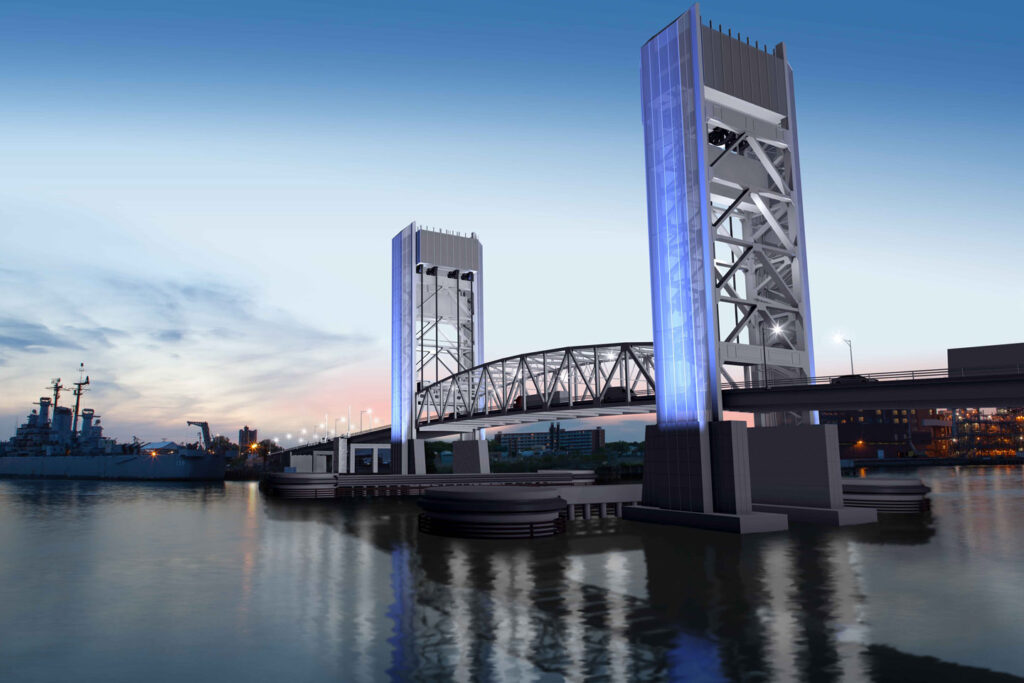
We served as the lead designer on MassDOT’s new Fore River Bridge Design-Build Project. The bridge is a vertical-lift bridge carrying Route 3A between Quincy and Weymouth, Massachusetts. It is one of the gateways to the Commonwealth’s South Shore. The bridge increased the existing channel width from 175 feet to 250 feet. Additionally, it increased the vertical clearance from 60 feet, 7 inches in the closed position to 175 feet, 7 inches in the open position.
Design Features Of The New Fore River Bridge
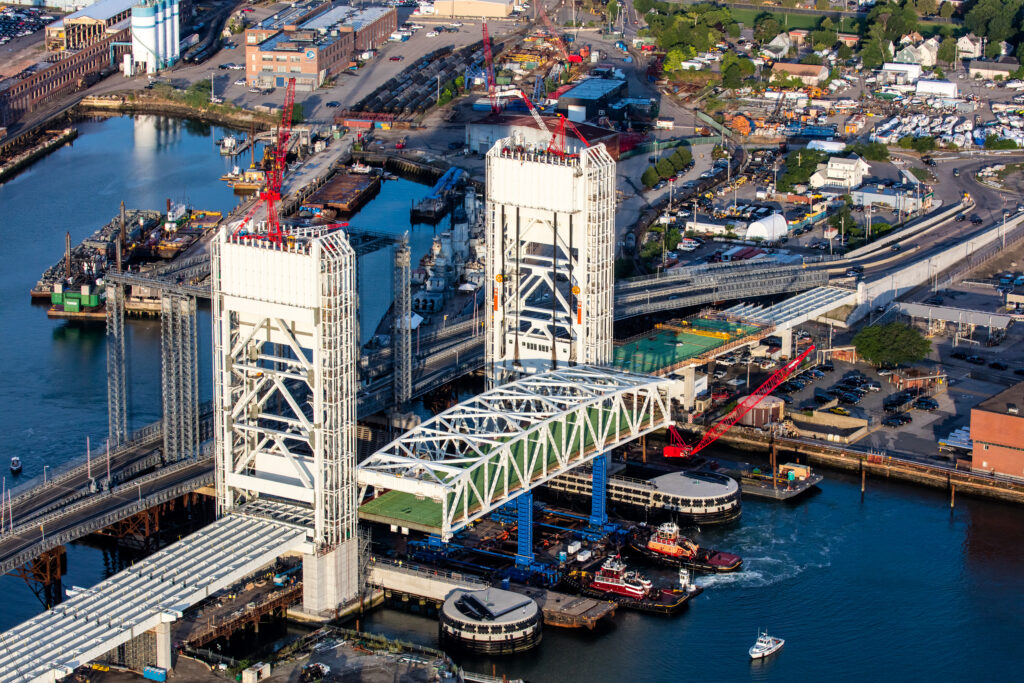
The new bridge’s main span uses a 324‑foot lift span made of a warren truss with floor beams and stringers that support a concrete deck.
Two 240‑foot‑tall steel towers carry the truss. Four 60‑foot‑tall concrete plinths support each tower. Six 8‑foot‑diameter drilled shafts, each extending roughly 130 feet to bedrock, anchor each plinth.
The bridge has two three-span approaches on each side of the main span. The east approach is approximately 520 feet long, and the west approach is approximately 466 feet long. Each approach structure consists of continuous 8-foot-deep welded plate girders supporting a concrete deck. There are four 12-foot-wide travel lanes and two five-foot-wide shoulders across the bridge with variable-width sidewalks on each side. Also included in the project was the rehabilitation of several hundred feet of existing approach retaining wall.
Maximizing Safety
To maximize safety and improve the schedule, the project team erected the lift span on land. They then used self‑propelled mobile transporters (SPMTs) to move it onto barges and float it into position.
The bridge machinery uses eight sheaves, four per side, each 20 feet in diameter, and is driven by dual 200‑HP electric motors. Each sheave carries ten ropes that raise and lower the 5,000‑kip lift span. A 2,500‑kip steel-and-concrete counterweight at each tower further assists this operation. The mechanical system also incorporates auxiliary counterweights, span guides, and span locks.
Clash Detection
With multiple disciplines working in tight spaces, the project team adopted clash detection features of BIM technologies early in the design process. Structural, architectural, lift‑machinery, and MEP teams each developed independent models. The team combined these models in clash‑detection software to validate spatial relationships and resolve conflicts digitally before fabrication. As a result, they avoided major construction conflicts on site.
Project Awards
- 2019 Grand Conceptor Award for Engineering Excellence from American Council of Engineering Companies of Massachusetts (ACEC/MA) on 03/20/2019
- 2019 National Recognition Award – Engineering Excellence from American Council of Engineering Companies (ACEC) on 01/1/2019

