Baltimore And Potomac (B&P) Tunnel Replacement Program — Baltimore, MD
Client

- Amtrak
Project Value 
$6 Billion
Market

Rail, Transportation
Services

Engineering
We play a pivotal role as part of the team serving as the Engineer of Record (EOR) for the Baltimore & Potomac (B&P) Tunnel Replacement Program, a transformative initiative replacing the aging B&P Tunnel on the Northeast Corridor. This critical ten-mile section is being modernized to relieve operational bottlenecks, improve rail efficiency, and respect Baltimore’s historic neighborhoods. The new tunnel design enhances safety, reliability, capacity, and speed while maintaining continuous rail service during construction.
Project Details
The design contract was awarded in 2013, with construction officially beginning in late 2024. Parsons has been a part of the project since its conceptual design stage in 2013 and will continue to provide comprehensive design and construction support services throughout the duration of the program, which is currently anticipated to be completed by 2036.
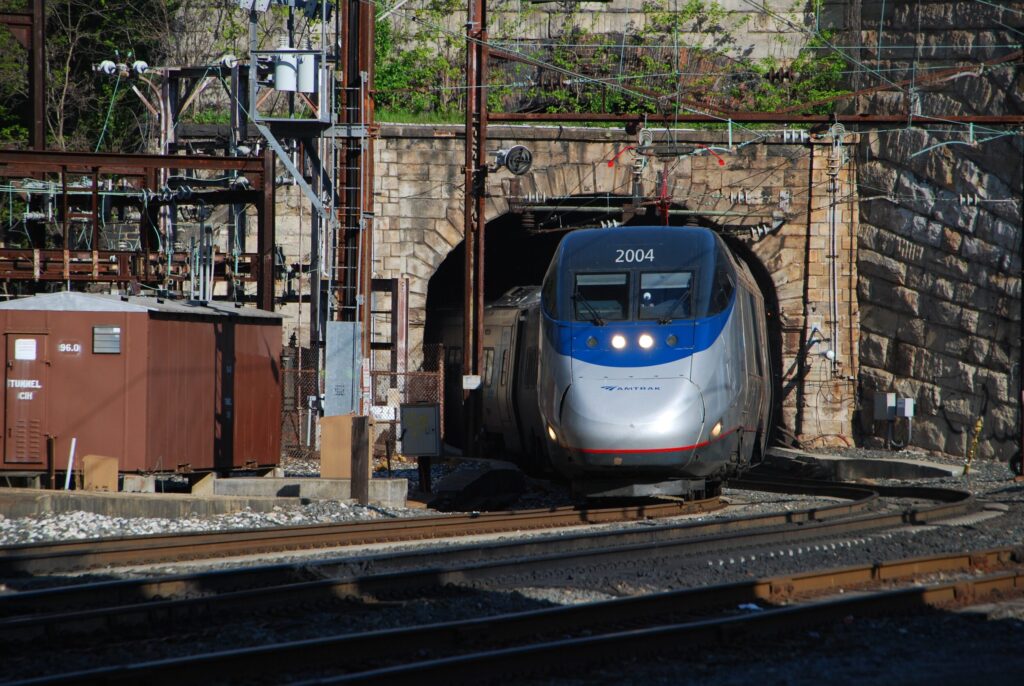
The existing tunnel features a 7,500-foot two-track tunnel consisting of three shorter tunnels connected by two open sections. It supports approximately 100 daily Amtrak regional and long-distance trains, MARC commuter trains, and Acela trips.
The existing tunnel’s sharp curves limit train speeds to 30 mph and suffer from water infiltration issues. The new design includes two single track tunnels of approximately two miles that smooth curves to allow speeds up to 100 mph and resolves structural challenges with modern engineering. Each track is housed in a separate bore, connected by cross passages and a mined emergency egress passageway, enabling conflict-free operations for passenger trains.
The Need For A Modern Tunnel
The B&P Tunnel opened in 1873 and is the oldest tunnel still in operation on the Amtrak network. Due to its age and deteriorating condition, it currently causes delays for commuters on 99% of weekdays, significantly affecting passenger travel along the Northeast Corridor. Despite previous rehabilitation efforts, the existing tunnel can no longer meet the demands of modern passenger rail service and cannot be expanded to meet future capacity or speed requirements.
To address these limitations, a new tunnel alignment has been designed. The new tunnel will accommodate fully electric Amtrak and MARC passenger trains, enable higher-speed travel, and meet current safety, environmental, and accessibility standards.
Parsons Role
As a part of the team serving as Engineer of Record, we are responsible for:
- Delivering preliminary and final designs for rail and highway bridges, track alignment, and construction staging
- Leading CMAR coordination for all rail and highway bridge designs to ensure constructability and sequencing
- Providing technical support during construction to ensure smooth design implementation
- Managing all aspects of design delivery, including railroad operations analysis, civil and structural engineering, fire/life safety, ventilation, drainage, electrical, communications, and security systems
- Coordinating with Amtrak, the Design Joint Venture (DJV) partners, and the CMAR contractor through dedicated task force meetings to streamline decision-making
- Coordinating design with internal and external partners including Amtrak Engineering, Maryland Transit Administration (MTA), and Baltimore City
In total, this transformative infrastructure program will modernize approximately 10 miles of Amtrak’s busiest and most heavily traveled passenger rail corridor, serving millions of riders annually.
Project Highlights
Obtained the Record of Decision from the Federal Railroad Administration by successfully navigating complex design and environmental challenges.
Received the 2018 Award of Excellence in the “Partnering: Non-Construction” category from the Maryland Quality Initiative.
Collaborated with Amtrak to implement the Construction Manager at Risk (CMAR) delivery model, improving project execution.
Designed three rail bridges and two highway bridges, all requiring close coordination with the CMAR, Amtrak and external stakeholders.
Innovative Solutions
- Balanced preservation of historic neighborhoods with operational needs through engagement with resource specialists and stakeholders
- Increased maximum speeds from 30 mph to 100 mph by softening tunnel curves, saving nearly three minutes in trip time and enabling full-length, high platforms at MARC West Baltimore Station while preserving its parking lot
- Designed emergency egress with separate bores for each track, connected by cross passages and a mined passageway
- Integrated significant rail systems utilities—traction power, signal power, and communications—within the bridge superstructures to maximize functionality and efficiency
Technical Expertise
- Designed three new interlockings and revised two interlockings using innovative solutions to address space constraints while maintaining uninterrupted operations on the Northeast Corridor
- Developed a detailed staging plan to reduce the corridor from four tracks to two while maintaining service along the Northeast Corridor
- Led design and coordination for highly skewed steel girder undergrade bridges ranging from 60’–80’ in length and 70’–90’ in width, each carrying four NEC tracks and utilities across Baltimore roadways
- Coordinated closely with Amtrak Engineering, Track, and Operations teams on complex efforts like the new Charles Interlocking
- Worked across multiple systems: overhead DC catenary (future corridor), underground Metro with third-rail power, surface light rail with catenary, and freight bridges with diesel operations—all within a constrained urban corridor
Complex Operational Environment
The tunnel corridor intersects with multiple active and future transportation systems powered by varying technologies. It requires simultaneous coordination of electrified passenger trains, diesel commuter trains, and freight traffic through a dense urban rail network. Parsons developed an integrated staging plan to ensure operational continuity while facilitating infrastructure upgrades, complex interlocking installations, and station enhancements.

