Advanced Geophysical Survey Solutions For Shallow-and Deep-Water Environments — Concord, CA
Client

- U.S. Army Corp of Engineers (USACE)
Project Value 
N/A
Market

Energy And Environment
Services

Engineering, Security Operations
Our geophysical survey solutions program in Concord, CA, was designed to maximize coverage, data quality, and personnel safety. We employed a dual-method approach tailored to the site’s unique challenges, which included:
- Helicopter-mounted magnetometers for efficient coverage of shallow-water estuaries
- Boat-towed magnetometers for areas deeper than 3 meters
Shallow Water Mapping
For efficient and comprehensive mapping of shallow-water estuaries, we utilized helicopter-mounted magnetometers. This enabled rapid data collection over broad areas that would otherwise be difficult to access by boat. Consequently, this aerial technique allowed us to detect subsurface metallic anomalies with high sensitivity while minimizing disturbance to the aquatic environment.
Deep Water Mapping
In areas where water depths exceeded 3 meters, we transitioned to boat-towed magnetometers. This method provided precise geophysical data in deeper zones. As a result, the entire survey area, including both shallow and deep-water environments, was thoroughly investigated. By integrating both helicopter and boat-based platforms, we achieved seamless data coverage and improved the reliability of our anomaly detection.
Safety First: Innovative Solutions For Challenging Waters
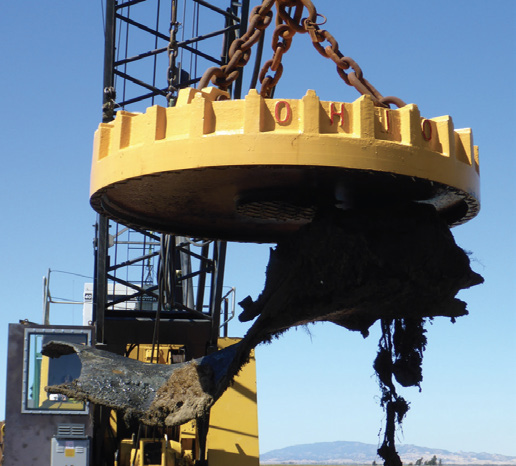
Suisun Bay presented significant operational challenges due to near-zero water visibility and strong tidal currents. These conditions posed substantial risks for traditional diver-based investigations. To overcome these hazards and maintain a high standard of safety, we deployed a specialized barge equipped with a crane-mounted electromagnet. This innovative setup allowed us to remotely retrieve metallic anomalies from the riverbed without exposing divers to dangerous conditions.
Once recovered, items were brought aboard the barge for secure and controlled visual inspection. Thus, we ensured the safety of field personnel and the integrity of the investigation process. This approach not only enhanced operational efficiency but also provided a reliable means of anomaly confirmation and documentation.
