Autoroute 31/Autoroute 40 Overpass Replacement And Temporary Interchange Reconfiguration In Lavaltrie, Quebec
Estimated reading time: 4 minutes
Across Canada, transportation agencies are increasingly asked to balance urgent infrastructure needs with long-term planning. Aging assets must be replaced quickly, traffic must keep moving, and communities cannot wait for perfect, future-state solutions. A recent highway interchange project in Quebec offers valuable lessons on how thoughtful design, collaboration, and a strong focus on safety can deliver lasting value, even when the solution is temporary.
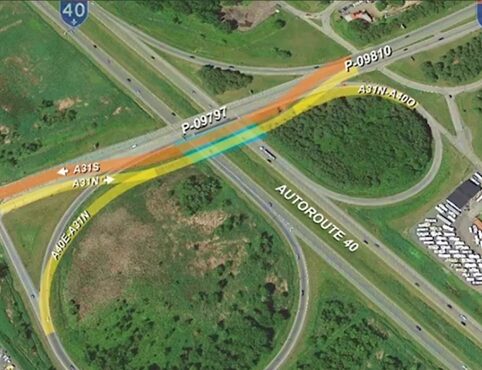
Located about an hour north of Montreal, the Autoroute 31–Autoroute 40 interchange required the replacement of an existing overpass following inspections that identified structural deficiencies. Québec’s Ministère des Transports et de la Mobilité durable prioritized construction of a new overpass to avoid service interruptions while longer-term plans for a full interchange redevelopment are studied. The challenge was clear: design an interim configuration that would safely serve motorists and the surrounding community for several years, while remaining compatible with a future permanent solution.
Putting Community Needs First
From the outset, the project was shaped by the needs of the people who rely on this corridor every day. Maintaining traffic flow in both directions on Autoroute 31 was essential, as was preserving access for local and agricultural vehicles. The temporary interchange configuration also had to fit between fixed tie-in points, an existing signalized intersection to the south and another existing overpass to the north. Both are to remain in place while their long-term redevelopment and integration into the future interchange is studied, leaving little room for traditional highway geometry.
Being unable to implement standard solutions into a constrained space, the design team focused on outcomes that matter most to users: predictable speeds, clear sight lines, and safe transitions. This user-centered approach helped ensure that, even with reduced widths and modified alignments, the roadway would feel intuitive, and at a minimum, and would prioritize safety for drivers navigating it for the first time.
Safety As The Primary Design Driver
One of the most important lessons from this project is learning the value of having safety guide every decision. Because not all modern design standards could be met within the available space, the team was required to prioritize critical safety criteria over driver comfort. Early in the process, a road safety audit was requested to validate assumptions and identify risks before detailed design progressed.
The result was a roadway with clearly defined speed zones, gradual acceleration and deceleration areas, and targeted geometric adjustments where needed. Where visibility was limited by vertical or horizontal constraints, the design was refined and enhanced signage was introduced. These measures help reduce uncertainty for drivers and lower the risk of sudden maneuvers an especially important consideration in a temporary configuration that will be in place for several years.
Building Responsibly On Challenging Ground
Another key challenge involved ground conditions. Portions of the new embankments would be built over unconsolidated clay soils, raising concerns about long-term settlement. Because some of these embankments may be reused in a future permanent interchange, the design adopted a long-term view, selecting pavement structures with a 30-year service life.
Lightweight fill was used strategically to limit settlement, paired with carefully designed transitions to conventional embankments. While largely invisible to the public, these decisions protect ride quality, reduce future maintenance needs, and support the responsible use of public investment. They also demonstrate how temporary infrastructure can be designed with durability and adaptability in mind.
Lessons That Extend Beyond One Project
Several broader lessons emerge from this work. First, flexibility is essential. When constraints make it impossible to apply standards “by the book,” engineers must adapt while staying grounded in sound safety principles. Second, early collaboration between designers, safety specialists, geotechnical experts, and the owner can prevent costly revisions later and build confidence in unconventional solutions. Finally, even temporary projects deserve long-term thinking. Designing interim infrastructure that can support future plans reduces waste, saves time, and benefits the community well beyond the initial mandate.
As Canada continues to modernize its transportation networks, projects like this highlight an important truth: success is not only measured by permanence. Sometimes, the most meaningful impact comes from temporary solutions that keep people moving safely today, while laying the groundwork for tomorrow.