From Transactional To Transformational: Rethinking Client Collaboration

Estimated reading time: 6 minutes
When consultants and clients work closely, aligning strategies and organizing creativity, they create trust, clarity, and innovation. This mindset is essential for bringing visionary ideas to life. Iconic initiatives in Saudi Arabia, such as NEOM, Diriyah Gate, King Salman Park, and Soudah Development, exemplify this approach. These projects, align with the goals of Saudi Vision 2030 and demonstrate how collective effort and strategic alignment can drive progress.
What Defines Healthy Collaboration?
Visionary architecture thrives when guided by a visionary client. As Sir Stuart Lipton, luminary British Property Developer once lectured, “The best buildings come from clients who demand great architecture, not just accept it.” A great client sets the tone from the very beginning, clear in purpose, ambitious in vision, yet realistic about the delivery challenges. They understand achieving excellence in the successful design and delivery of the project is an investment; and that the route to achieving it lies in partnerships.
Balancing Visionary Design With The Delivery
Consultants delivering these projects are not just service providers. They are collaborative co-creators. Aligning with the client’s vision is critical, but so is healthy dialogue and open communication. The consultant must challenge, question, and refine to transform the project into a bold, buildable reality. Collaboration, at its best, means everyone at the table owns both the risk and the reward of great design.
For clients seeking to get the best out of their partnerships, three principles stand out:
- Clarity – A well defined brief sets a clear vision and direction for the project.
- Consistency – Strong, steady leadership ensures alignment and focus across the team.
- Constant Engagement – Open, ongoing communication fosters a collaborative exchange of ideas and feedback.
By embracing these principles, clients can unlock the full potential of their partnerships and drive innovative outcomes. The early phase of a project should focus on alignment, setting a North Star that all stakeholders can navigate by.
This collaboration at project inception pays dividends later, reducing design drift, cost escalation, and friction between disciplines.
Bridging The Gap Between Client And Consultant
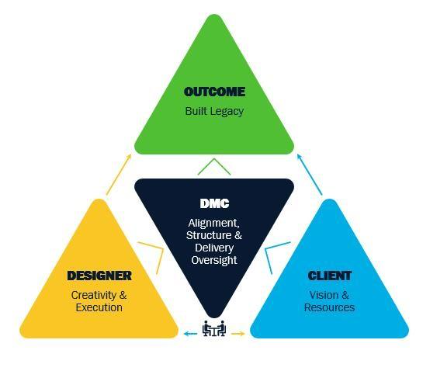
As Design Management Consultants (DMCs), our role is to support both the client and the consultant, and keep the vision alive while holding everyone accountable for the performance expected of them.
The most successful client – DMC – consultant partnerships are founded on structured collaboration. This translates to a well researched brief, transparent governance, and the integration of design thinking into the delivery strategy.
Design must not exist in isolation from construction or commercial realities. Instead it should be informed by them allowing creativity to thrive within clear parameters.
Early strategic clarity, supported by structured competition frameworks and disciplined delivery processes, attracts global talent and creates efficiency.
The result is not just an iconic structure, urban development, airport or bridge, it’s a legacy. Projects that stand the test of time because they were founded on trust, clarity, and a shared commitment to excellence.
Navigating The Dynamics Of Project Design Management
Designers often perceive project managers to be interfering in the intimacy of the client/designer relationship. In many situations the professionals involved in the design process project manage exceptionally well themselves, and the results can be fantastic. The challenge really occurs where the client is new to the game of development, or new to a sector. Without strategic direction the designer must start making professional judgements based on experience, on behalf of the client which can be risky.
As the client body evolves and matures into a larger organization bringing in operational specialists and subject matter experts that have delivery responsibility, decisions are revisited without a traceable rationale and difficult questions begin to get asked. “Why was this put there? Who approved it? Were you qualified to provide that guidance” etc. Designers must “fill the void,” substituting professional judgment for absent strategy. Without a single source of truth, each stakeholder optimizes locally; the project sub-optimizes globally.
The emphasis of Project Design Management should always be focused on getting the best out of the client and the designer.
Key Risks To Consider:
- Strategic drift: Design proceeds without a stable, shared definition of value, leading to rework when executive/operational voices re-enter.
- Decision ambiguity: Unclear authority and approvals create slow, inconsistent decisions and “design by email”.
- Late changes: Assumptions made early are overturned by later stakeholders, triggering costly rework and delays.
- Scope creep and fragmentation: Disconnected packages, unclear interfaces, and inconsistent standards inflate cost and time.
- Operational misfit: Assets don’t meet end-user, operator, or maintenance needs, raising lifecycle cost and diminishing performance.
- Compliance and ESG gaps: Late discovery of regulatory, code, or sustainability shortfalls jeopardizes permits, reputation, and targets.
- Supplier and contract friction: Poor briefs and shifting requirements yield claims, change orders, and adversarial relationships.
- Erosion of trust and morale: Designers feel second-guessed; clients feel unheard; creativity becomes defensive rather than generative.
Project design management can be transformational. It establishes clear intent and decision rights through a living brief, shared value drivers, and a RACI (Responsible, Accountable, Consult and Inform) matrix that everyone respects. It embeds early and continuous stakeholder integration, supported by stage gates that assure the brief is being adhered to.
Delivering Excellence In Design And Procurement For The Royal Arts Complex
As PMO for King Salman Park (KSP), we supported the King Salman Park Foundation (KSPF), its key stakeholders, the Royal Commission of Riyadh City (RCRC) and the Ministry of Culture (MOC), and the lead design consultant, Bofill Taller de Arquitectura, in delivering the design and integrated procurement strategies for the park’s signature cultural asset, the Royal Arts Complex.
We protected design intent by making the brief explicit, decisions accountable, and change transparent. By applying the principles outlined above, we reduced abortive design by engaging the right stakeholders at the right time and proving compliance early. We accelerated delivery by turning creativity into commitments, traceable, buildable, and operable.
“Working with Parsons on the Royal Arts Complex has been a highly productive and collaborative experience. From the outset, their professionalism and structured approach created the right conditions for a complex design process. They provided clarity, consistency, and trust, allowing us to explore ideas freely while ensuring alignment with the project’s wider vision.” – Pablo Bofil, CEO Bofill Taller de Arquitectura