Electrical Resistance Heating Remediation In Europe During Covid-19 Pandemic
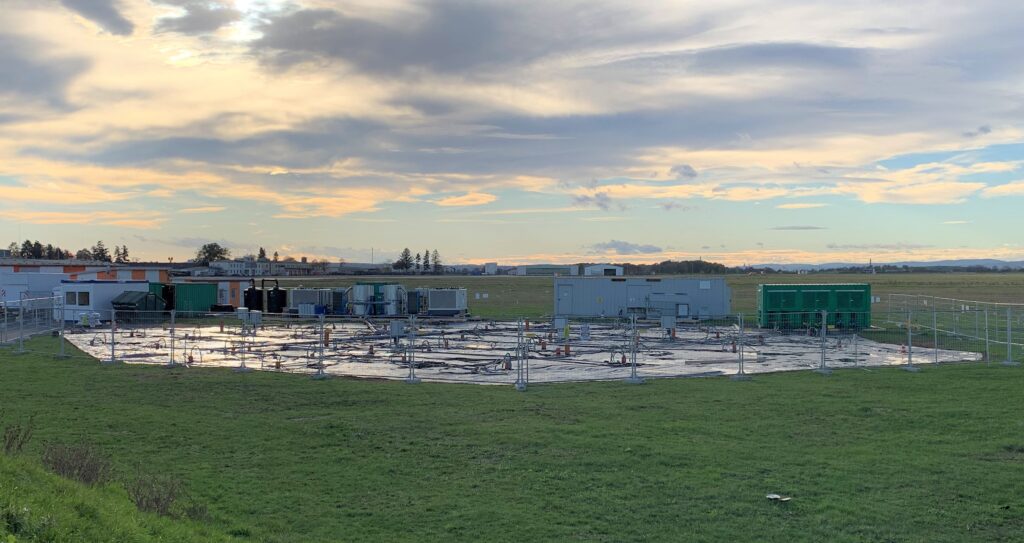
We completed the first electrical resistance heating (ERH) project in Germany in May 2021. The site at US Army Garrison (USAG) Wiesbaden was a former maintenance area near the airport runway. The constituents of concern (COCs) were chlorinated volatile organic compounds (VOCs), primarily trichloroethene (TCE).
ERH involves injecting electricity into the subsurface, which acts as a resistor and heats up to the boiling point of water in about two months. The generated steam acts as a carrier gas, transporting the volatilized COCs to the vadose zone, where TRS captures the contaminants and treats them conventionally at the surface. ERH works equally well in the vadose and saturated zones, even in tight matrices such as clay and sedimentary bedrock. Expected VOC concentration reductions are 99% or more.
The goal of the thermal remediation at USAG Wiesbaden was to reduce TCE groundwater concentrations in the source area where concentrations exceeded 10,000 micrograms per liter (µg/L). The treatment area was approximately 1,110 square meters and extended from 2 to 12 meters below ground surface for a treatment volume of 11,100 cubic meters.
Our OptiFlux® ERH services included 57 electrodes with co-located vapor recovery points. A 2,700-kilowatt power control unit provided electricity to the dual-element electrodes and the above ground vapor treatment equipment, which included two steam condenser and chiller units, and vapor granular activated carbon vessels.
Construction of the OptiFlux® system began on July 6, 2020, and operations extended from November 24, 2020, to May 4, 2021, during the Covid-19 pandemic. TRS, with the help of our client Wood E&IS GmbH, USAG base personnel, US Army Corps of Engineers, and TRS European partners Cornelsen, Ltd. and HMVT, navigated the many travel and logistical challenges to construct and operate the OptiFlux® system as designed. Over 50 Covid tests were taken over the course of the project.
Baseline TCE groundwater concentrations ranged from 116 to 9,980 µg/L and post remediation concentrations ranged from 7.0 to 79 µg/L, resulting in an average reduction of 99%. Completion of the complex project during a pandemic is a testament to the team’s commitment to meet client project goals despite unexpected adversity.